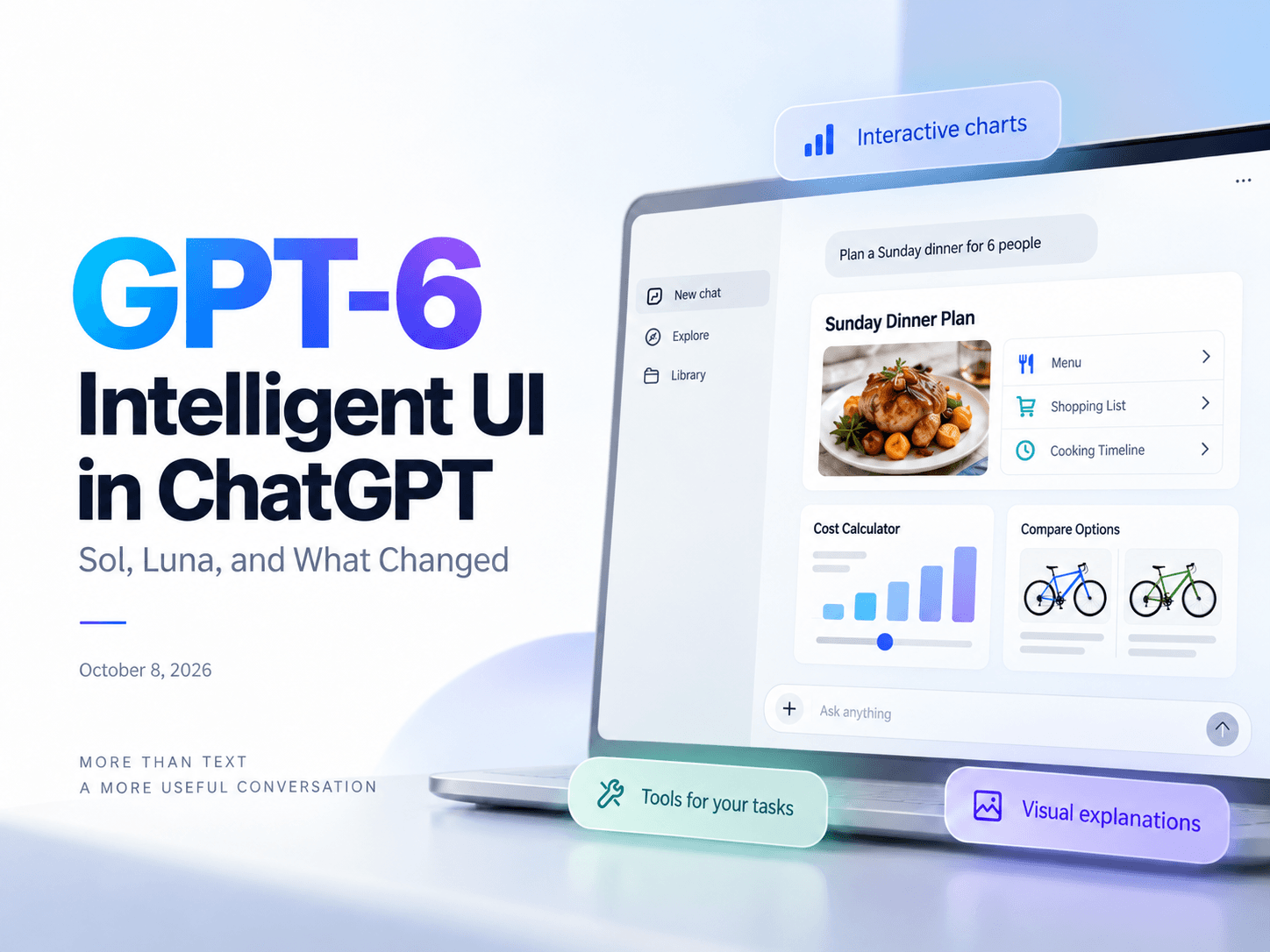
A question about a 7-speed bike no longer has to come back as a wall of text. On October 7, 2026, OpenAI turned on Intelligent UI in ChatGPT Chat. The reply can be a diagram you tap, a chart, a form, or a small tool built for that one task. A loose Sunday dinner plan can come back as a menu, a shopping list that changes with the guest count, and a cooking timeline.
This is also how OpenAI is putting a new GPT-6 model in front of the more than 1.2 billion people it says use ChatGPT each week. Plus, Pro, Business, and Enterprise get GPT-6 Sol. Free and Go get GPT-6 Luna, with that rollout set to begin on October 8. Answers can start while the model is still thinking.
What OpenAI announced
Last month, OpenAI introduced the first GPT-6 models for paid customers. The October 7 update is the everyday Chat version, with Intelligent UI in the Chat tab.
Paid Chat plans run on GPT-6 Sol. Free and Go run on GPT-6 Luna. OpenAI says both are tuned for everyday conversation. The October system card says these models replace GPT-5.6 Sol and GPT-5.6 Luna in ChatGPT.
Astra stays a separate model. OpenAI says this Chat release builds on several of Astra’s safety advances. The earlier Astra release is covered in GPT-6 Astra vs GPT-5.6 Sol.
What Intelligent UI actually does
GPT-6 can mix text, visuals, and interactive elements, and pick the mix from the question.
OpenAI says a response can include:
- graphics
- tappable buttons
- forms
- charts
- interactive experiences you use inside the conversation
A comparison can sit side by side. An explanation can use an interactive diagram. A simple question can still get plain text.
The announcement shows three uses.
Everyday plans. Roast timing can sit next to the recipe. Road-trip stops can sit on a map, with notes on detours. The page itself shows a lamb-roast plan with a menu, quantities by guest count, and a schedule.
Harder explanations. You can see how something works, change an input, or move through a problem one step at a time. The bicycle demo splits the bike into frame, wheels, drivetrain, brakes, and cockpit.
A tool for the task in front of you. OpenAI’s examples are a savings calculator, a dinner bill splitter, and a game inside the chat.
OpenAI also says design judgment, and the range of interfaces the model can create, still need work.
How the interface is generated
Two pieces sit behind Intelligent UI.
A library of native components can stream. The look stays familiar on web and mobile, and the model decides how the pieces fit the question.
A compiler builds the interface while the model is still writing. Parts of the screen can show up before the full answer is done.
OpenAI says training now covers content, layout, visuals, and interaction. Interfaces were judged on clarity, usefulness, and completeness, including when a text answer is enough.
Answers can start before thinking finishes
Earlier reasoning models could take on harder questions, and the user waited until thinking finished. GPT-6 can think and answer in turns.
OpenAI says the model was trained to weigh waiting time and to write from what it knows so far. The answer can arrive in several parts. Each part is meant to add something useful, and the finished answer is meant to read as one factual response.
Two internal results:
- On high-value, everyday agentic tasks, GPT-6 Extra High can begin answering in the same time as GPT-5.6 Medium, with a better overall score than GPT-5.6 Extra High.
- On questions that need web search, GPT-6 Instant starts answering 44% sooner, on average, than GPT-5.6 Instant.
OpenAI also says GPT-6 is better at deciding when to look something up, and better at finding information that supports the answer. On difficult problems, it addressed the key part of the question more often than GPT-5.6. No percentage was published for that quality result.
Safety, in brief
OpenAI says this GPT-6 is better at recognizing real-world risk, answering honestly, and respecting limits a person sets. Updated training targets high-risk misuse involving cyberattacks, biological threats, and violence. In adversarial tests, it resisted bypass attempts more strongly, especially attacks that change across turns. It is also trained to refuse fewer harmless requests by using the conversation, not only the latest prompt.
The October 7 system card treats GPT-6 Sol and GPT-6 Luna as High capability in cybersecurity and in biological and chemical work, and below the High threshold for AI self-improvement. Safeguards match the GPT-5.6 system card. The card also records some lower safety scores and OpenAI’s review of them.
Who can use it, and where
As published on October 7, 2026:

Codex and ChatGPT Work stay on the previously released September versions of GPT-6 Sol and GPT-6 Luna. This announcement gives no consumer price, API price, or context-window figure.
Where ChatGPT stops and listing work starts
Intelligent UI changes the shape of an answer inside ChatGPT. A team can compare options, sketch a plan, or turn a rough brief into a checklist there.
Amazon listing work still needs titles, bullets, search terms, product images, and A+ or EBC modules in the format a storefront expects. That production step is what BeePOP is for: create listing copy and images in one workflow, then review and export them. A managed ChatGPT workspace for the research step is a separate decision, covered in ChatGPT Business pricing and features.
FAQ
Is this ChatGPT release the same model as GPT-6 Astra?
Astra is a separate GPT-6 model. This Chat update uses GPT-6 Sol on paid plans and GPT-6 Luna on Free and Go. OpenAI says those Chat models build on several of Astra’s safety advances.
Do Codex and ChatGPT Work get Intelligent UI?
This release is the Chat tab. The October system card says Codex and ChatGPT Work remain on the September versions of GPT-6 Sol and GPT-6 Luna.
What did OpenAI leave out of the speed claims?
The published speed figure is specific: GPT-6 Instant starts web-search answers 44% sooner, on average, than GPT-5.6 Instant. The quality claim, that GPT-6 more often covered the key part of a hard question, has no percentage. Subscription prices, API prices, and context length are also absent from this announcement.
Where are the full safety results?
In the October 7 system card for GPT-6 Sol and GPT-6 Luna. It sets the preparedness ratings and records where some safety scores came in lower than GPT-5.6.
Sources
- OpenAI, GPT-6 and Intelligent UI for everyone, October 7, 2026. The Chinese page is here. Figures in this article follow the English post, including the 44% web-search comparison.
- OpenAI Deployment Safety Hub, GPT-6 Sol and GPT-6 Luna: October 2026 update, published October 7, 2026. This is the system card linked from the announcement.