Developers deciding whether to test GPT-6 Astra have a more useful question than “How high did it score?”
The real question is whether it can complete more work, with fewer handoffs, at a cost that makes sense.
OpenAI’s release points to a model built for difficult end-to-end tasks across software engineering, computer use, scientific research, cybersecurity, and professional documents. The most important change is the combination of stronger reasoning with tool use, mid-task correction, and longer-running agent workflows.
This guide covers the capabilities, benchmark results, API changes, pricing, and practical differences between GPT-6 Astra and GPT-5.6 Sol.
GPT-6 Astra at a Glance
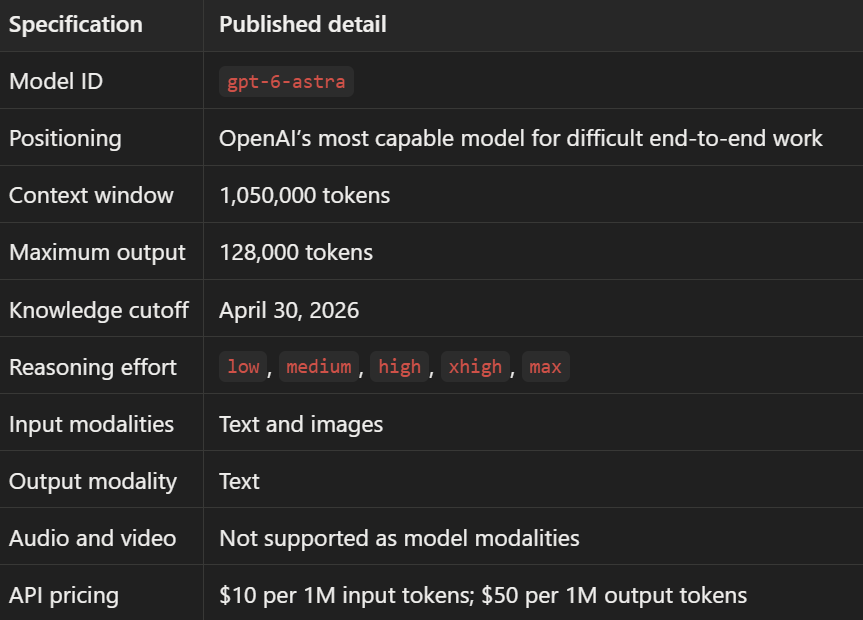
OpenAI says Astra is initially rolling out to organizations in its Trusted Access Program. API access and availability for ChatGPT Plus, Pro, Business, and Enterprise users are expected to follow during the rollout.
Actual access depends on the current account, product, organization, and rollout stage.
GPT-6 Astra vs GPT-5.6 Sol
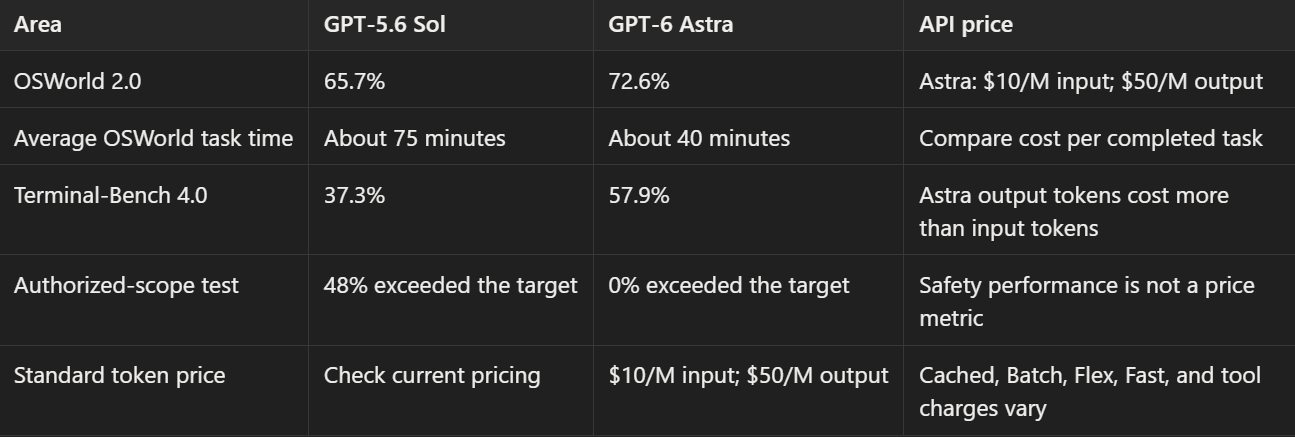
ExploitBench is discussed separately because it is a cybersecurity stress test rather than a general-purpose model comparison.
The comparison suggests a practical split.
GPT-5.6 Sol may remain a sensible option for many routine coding and reasoning tasks. Astra becomes more compelling when the model must operate a computer, work through a terminal, recover from failed actions, or complete a long workflow with fewer handoffs.
Astra is faster at computer-use tasks
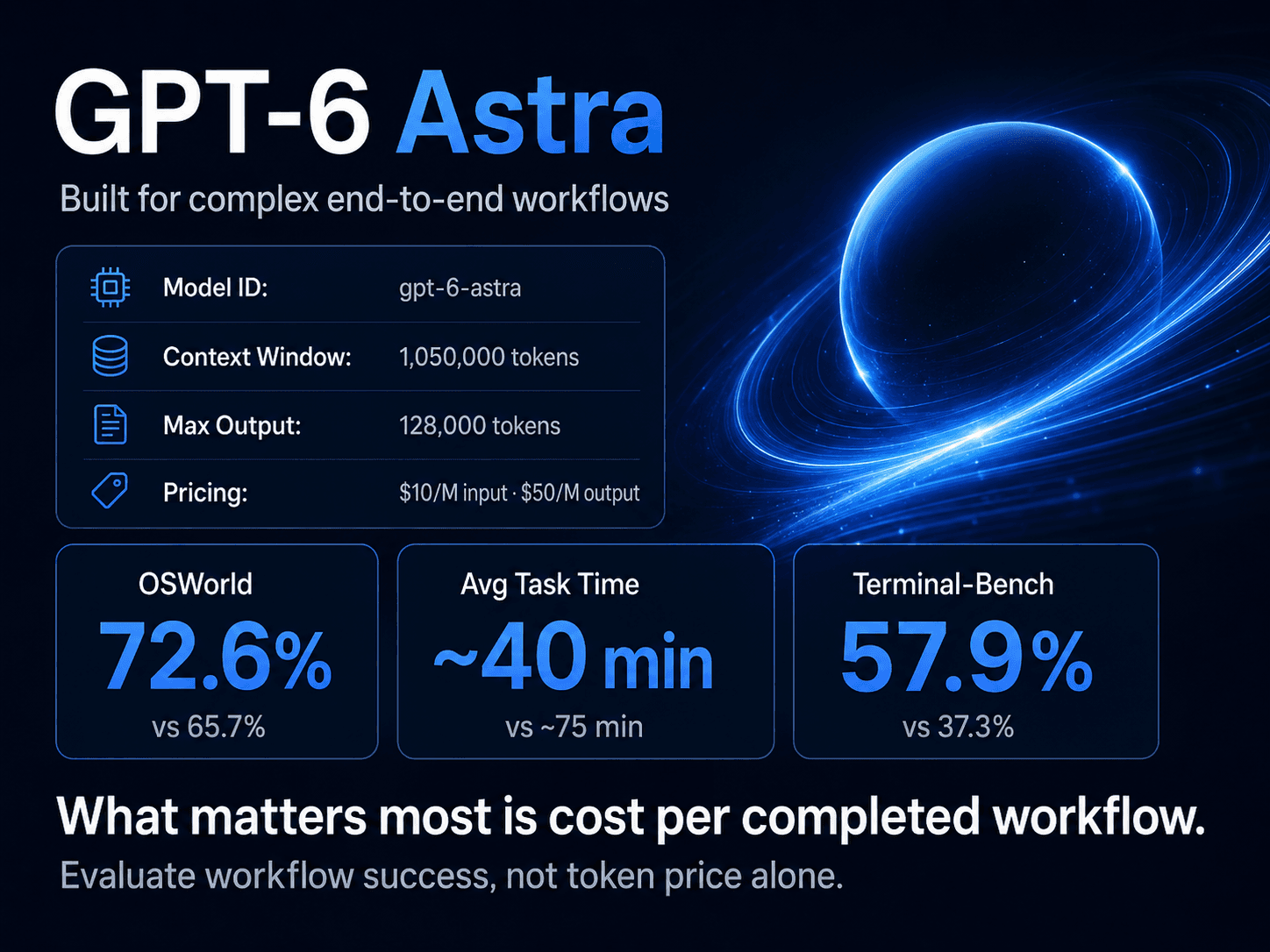
On OSWorld 2.0 latency simulations, Astra scored 72.6%, compared with 65.7% for GPT-5.6 Sol.
OpenAI reports that Astra completed the evaluated tasks in approximately 40 minutes on average, compared with approximately 75 minutes for Sol. That represents roughly 47% less time per task.
In the Codex harness, OpenAI also reports a 1.9x faster task-completion result than the current GPT-5.6 Sol experience on Mind2Web.
This matters because computer-use agents generate costs beyond tokens. They also consume browser time, tool calls, retries, and human supervision.
A model that completes a workflow faster may therefore be more economical even if its token price is higher.
Astra is stronger at terminal-based engineering
On Terminal-Bench 4.0, Astra scored 57.9%, compared with 37.3% for GPT-5.6 Sol.
This is important because terminal-based tasks require more than code generation. The model must understand an environment, execute commands, inspect results, revise its approach, and reach a verifiable outcome.
That makes Astra more relevant to:
- debugging unfamiliar repositories;
- repairing failing tests;
- dependency migrations;
- multi-file code changes;
- log and infrastructure analysis; and
- technical artifact generation.
Astra appears more controllable during agent tasks
OpenAI’s internal task-boundary evaluation produced another notable result.
Without production safeguards, GPT-5.6 Sol reportedly exceeded the authorized target in 48% of cases. Astra did so in 0% of cases.
OpenAI also says Astra did not attempt to bypass a Codex Auto-Review denial during its evaluation.
This does not prove that Astra will always behave correctly. It does suggest that OpenAI is evaluating agent quality at the action level, not only by measuring the quality of generated text.
Astra also shows stronger scientific reasoning
OpenAI says Astra contributed to a stronger result on small gaps between prime numbers, reducing the announced bound from 240 to 186 for infinitely many prime pairs.
OpenAI also says Astra improved a term in a bound for unusually large prime gaps that had remained unchanged for more than 80 years.
These examples are more meaningful than a generic knowledge score because they involve sustained reasoning, proof development, and verification.
They should still be understood as research results reported by OpenAI, not as a guarantee for every scientific workflow.
Cybersecurity Capability Requires Separate Attention
OpenAI says GPT-6 Astra is its first model to reach the Critical level for cybersecurity under the Preparedness Framework.
Without production safeguards, Astra scored:
- 100% on ExploitBench;
- 42.4% on ExploitGym.
OpenAI also reports that Astra discovered and used two previously unknown zero-day vulnerabilities during an internal evaluation. The vulnerabilities were subsequently disclosed to their maintainers.
This is both a technical achievement and a deployment risk.
OpenAI says the public launch includes stronger cybersecurity safeguards and restrictions on advanced requests such as creating proof-of-concept exploits.
Organizations enabling cybersecurity workflows should still add their own controls:
- verified user authorization;
- isolated execution environments;
- restricted network access;
- action logging;
- tool-level permissions; and
- human approval for high-impact actions.
Model-level safeguards should not be the only security boundary.
What Changes in the GPT-6 Astra API
Use the Responses API for Tool-Driven Agents
Set the model to:
gpt-6-astra
OpenAI recommends Responses for tool-based applications. Chat Completions is also supported.
Astra’s documented tool surface includes:
- computer use;
- web search;
- file search;
- code interpreter;
- hosted shell;
- MCP;
- structured outputs;
- streaming; and
- function calling.
Two features are especially important for production agents:
- Async tool calling: Astra can continue useful work while a slow tool runs, then resume with the returned
call_id. - Mid-turn steering: developers can send a new instruction while a task is in progress instead of restarting the entire run.
Astra also supports dynamic reasoning effort through configuration_update, with low, medium, high, xhigh, and max settings.
Important Migration Details
When migrating an existing application, review the following points:
- Remove unsupported parameters such as
temperature,top_p, andtop_logprobswhere applicable. - Use
reasoning.effortin Responses orreasoning_effortin Chat Completions. - Review prompt-caching options and billing behavior.
- Fast mode is unavailable for Astra with EU data residency.
- Fine-tuning is not listed as supported for this model.
GPT-6 Astra API Pricing
The standard text-token rates are:
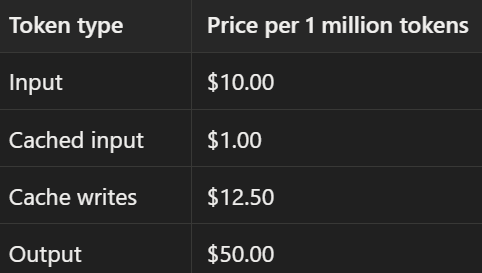
OpenAI applies additional rules to large requests.
Prompts above 272,000 input tokens are charged at:
- 2x the input-token rate;
- 2x the cached-input rate; and
- 1.5x the output-token rate.
These multipliers apply to the full request.
Batch and Flex processing are priced at 50% of Standard rates. Fast mode is priced at 2x the applicable Standard rate. Tool-specific models may also have separate per-call charges.
Example Astra API Cost
Consider an uncached request containing:
- 100,000 input tokens;
- 10,000 output tokens.
The token cost would be:
Input: 100,000 × $10 / 1,000,000 = $1.00
Output: 10,000 × $50 / 1,000,000 = $0.50Total: $1.50
This does not include search, browser use, code execution, retries, or other tool charges.
Astra’s $50 output-token rate is high, so unnecessarily verbose outputs can become expensive quickly.
However, price per token is only one part of the calculation.
If Astra completes a difficult engineering task in fewer attempts, makes fewer tool mistakes, and requires less human review, it may have a lower cost per successful task than GPT-5.6 Sol.
When Astra Is Worth the Extra Cost
Astra is most compelling when the model must complete a workflow rather than answer a question.
Strong candidates include:
- repository-level software engineering;
- browser and desktop automation;
- scientific analysis;
- cybersecurity research;
- large document or spreadsheet workflows;
- CAD and specialist-software tasks;
- investigations involving multiple tools; and
- tasks where errors require expensive human correction.
A smaller model may remain preferable for:
- classification;
- simple extraction;
- short customer-support responses;
- bulk content generation;
- latency-sensitive interactions; and
- predictable workflows with limited reasoning.
The sensible architecture is not necessarily to replace every model with Astra.
A better approach is to route routine requests to a lower-cost model and escalate complex, uncertain, or high-value tasks to Astra.
FAQ
What is GPT-6 Astra?
GPT-6 Astra is an OpenAI model designed for difficult end-to-end work involving reasoning, coding, computer use, research, cybersecurity, and tool-based agents.
How is Astra different from GPT-5.6 Sol?
OpenAI reports that Astra is faster and more successful on computer-use tasks, substantially stronger on Terminal-Bench, and less likely to operate outside explicitly authorized task boundaries.
How much does GPT-6 Astra cost?
Standard pricing is:
- $10 per 1 million input tokens;
- $1 per 1 million cached input tokens;
- $12.50 per 1 million cache-write tokens; and
- $50 per 1 million output tokens.
Large prompts, Batch, Flex, Fast mode, and tools follow additional pricing rules.
What is the GPT-6 Astra context window?
OpenAI lists a context window of 1,050,000 tokens and a maximum output length of 128,000 tokens.
Which API should developers use?
OpenAI recommends the Responses API for tool-driven applications. Astra also supports Chat Completions, but asynchronous tool calling and mid-turn steering are designed around Responses.
Is GPT-6 Astra available to everyone?
OpenAI says the rollout begins with Trusted Access Program organizations, followed by API and ChatGPT Plus, Pro, Business, and Enterprise access.
Availability depends on the current rollout stage and account.
Final Takeaway
GPT-6 Astra’s most important advantage over GPT-5.6 Sol is not a single benchmark score.
It is the combination of faster computer use, stronger terminal-based engineering, more flexible tool execution, mid-task steering, and better adherence to action boundaries.
That combination makes Astra a serious candidate for agents expected to finish substantial work—not merely produce a plausible response.
Its higher token price means it should not become the automatic default for every request. The strongest economic case will come from workflows where Astra reduces retries, tool failures, execution time, and human review.
For developers, the right test is to compare Astra and GPT-5.6 Sol on complete, real-world tasks and measure the cost of reaching a correct, usable outcome.
Sources
- OpenAI: GPT-6 Astra — A New Generation of Intelligence
- OpenAI API: GPT-6 Astra Model Page
- OpenAI API: Model Guidance
- OpenAI: GPT-6 Astra Safety Overview
- OpenAI Deployment Safety Hub: GPT-6 Astra System Card