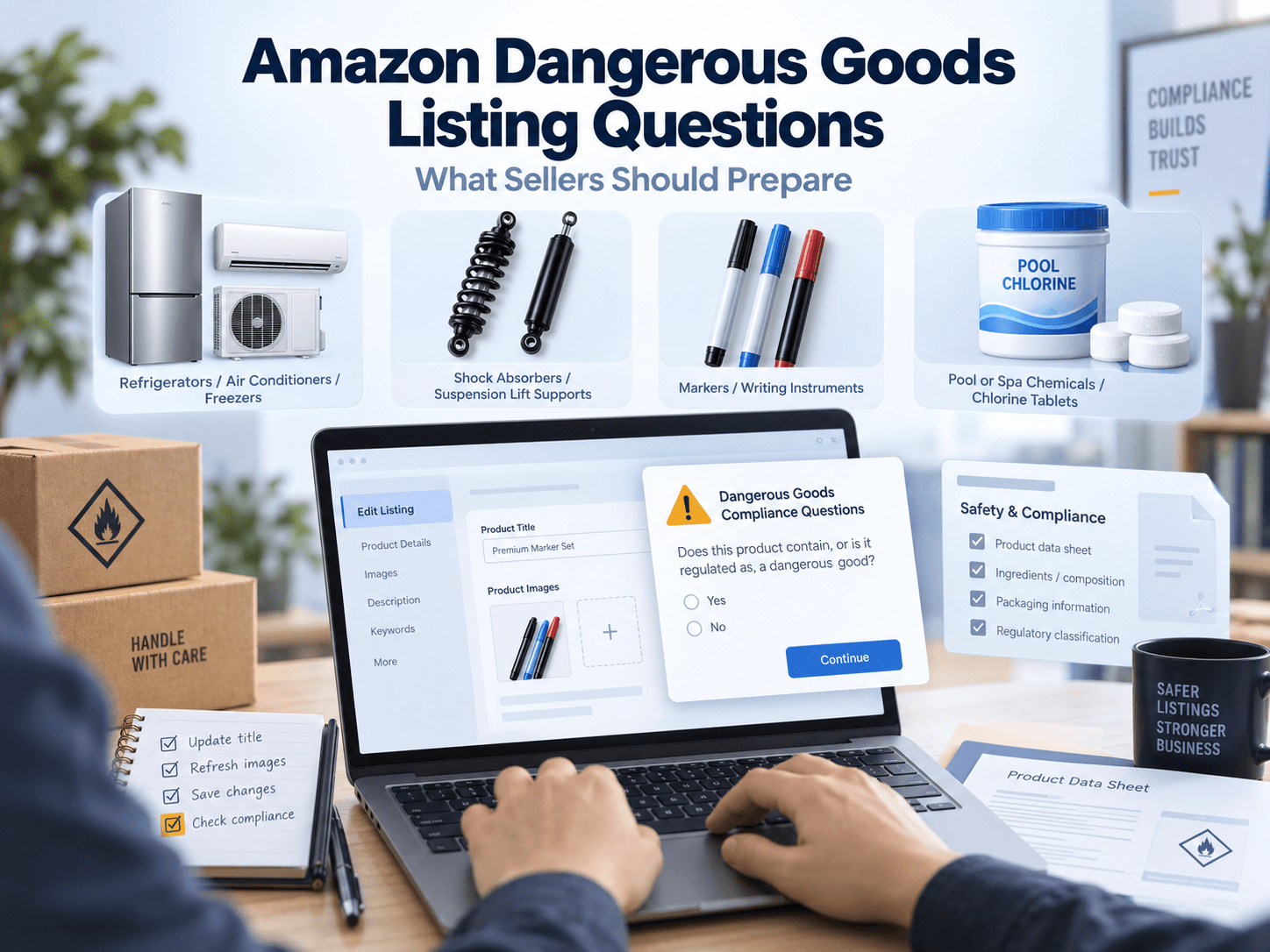
A title change or an image refresh can now stop on a compliance form. From October 26, 2026, Amazon says sellers who create or edit listings in four product groups will be asked new dangerous-goods questions: refrigerators, air conditioners, freezers, and similar products; shock absorbers and suspension lift supports; markers and writing instruments; and pool or spa water-treatment products.
If you plan to update any of those listings before peak season, get the factory specs first. A refrigerant charge, ink type, or chemical composition that exists only in a supplier chat can leave the edit waiting on that form.
Amazon says the questions help it identify dangerous goods, allow more shipping methods, and reduce disposal costs caused by incomplete product data. The notice ties the questions to creating or editing a listing. Confirm the live form in Seller Central before you run a large batch of updates.
Which listings are covered
Amazon names four groups, and only these four:
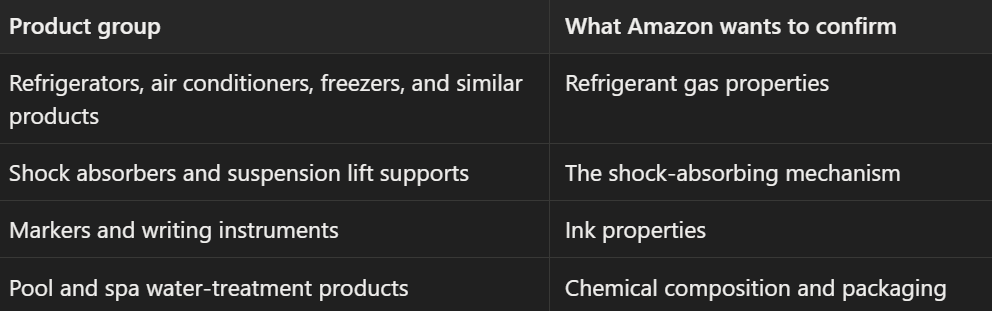
“Similar products” is Amazon’s wording for the appliance group, alongside refrigerators, air conditioners, and freezers. This notice does not add a separate list for accessories, replacement parts, or other categories. If an ASIN is clearly one of the four, prepare its file. If it sits outside them, use the questions Seller Central shows on that ASIN.
The form sits under Dangerous goods (hazmat) required information and documentation. Changing a title, bullet, image, or attribute on a covered ASIN may bring it up. Check one listing in your account before a whole catalog goes through.
What to have on hand
Field names below are from Amazon’s dangerous-goods flow, as recorded by Goat Consulting after the September 25, 2026 announcement. Match them to the form in your account.
Refrigerant appliances. Reported fields cover whether the unit ships pre-charged, the refrigerant type, the refrigerant code (such as R-32 or R-290), the volume, and the charge as a range in grams. Take the code from the nameplate and the charge from the spec sheet. If the sheet uses ounces or pounds, convert it to grams. Newer U.S. models may use a different refrigerant from older ones under the EPA Technology Transitions program, so keep the figure by model.
Shock absorbers and suspension lift supports. Have the manufacturer describe the shock-absorbing material or mechanism in writing, and be ready for a certification related to a dangerous-goods exception.
Markers and writing instruments. Have the ink base, the marker type, and the main ink properties. Alcohol-based, solvent-based, and water-based inks are different answers.
Pool and spa chemicals. Goat Consulting reports questions on whether the product is more than 80 percent trichloroisocyanuric acid, whether the net mass of that ingredient is over 1 kg, and whether each unit is individually wrapped. Some chlorinating products are also EPA-registered pesticides, which is a separate requirement.
What a thin file can affect
Amazon’s dangerous-goods guide classifies the finished product, and it may ask for this information even when you believe the item is not regulated. A thin or conflicting file can mean a longer review, a request for more documents, or an offer that stays unavailable until the file is accepted.
For inventory already in a fulfillment center, Amazon’s guide describes a 14-business-day window to supply requested safety information. Delayed shipments, canceled deliveries, or disposal at your expense are among the outcomes listed if that window closes without a complete response. Goat Consulting reports that a complete FBA submission is often reviewed in about two business days, and that a resubmission starts another cycle. For refrigerant products, the same account says Amazon looks for a safety data sheet from the last five years, with the standard 16 sections, using the same product name and brand as the detail page.
The document, the form, and the detail page clear faster when they describe the same product. Keep the refrigerant code or chemical strength in your bullets aligned with the answer you submit.
Before you open the listing
- List the ASINs you will actually create or edit in the four groups.
- Attach a spec sheet or SDS that names the model: refrigerant code and charge in grams, shock mechanism, ink base, or pool-chemical composition and packaging.
- Get that file from the manufacturer in writing, and store it where the person editing the listing can open it.
- Read the title, bullets, and images against it.
- Submit the edit once the answers are ready, then check the ASIN under Manage dangerous goods classifications.
If the edit is a copy or image refresh, finish those assets before you open the live listing. BeePOP can draft the listing copy and images from a product photo and a short description. Put the manufacturer’s specs into that brief first, so any refrigerant or chemical detail in the copy matches the form.
FAQ
Do listings I am not editing need an update on October 26?
Amazon’s notice attaches the questions to creating or editing a listing, so an ASIN you leave untouched may not surface the form that day. It is still worth checking Manage dangerous goods classifications for any open document request. Confirm the behavior on one of your own listings.
What if the product is not a dangerous good?
You may still be asked. Amazon’s identification guide requests this information because classification follows the finished product. If the page asks for a safety data sheet or an exemption sheet, send the document type that workflow accepts, with the file name and ASIN matched to the listing.
Does this apply only to FBA?
The notice is about creating and editing listings, and it does not limit the questions to Fulfillment by Amazon. An unfinished file is most likely to delay receiving or block an offer on FBA. Merchant-fulfilled listings can still be asked for the same answers.
Sources
- Amazon Seller Central — New compliance questions for dangerous goods listings apply October 26.
- Amazon — Dangerous Goods Identification Guide.
- Amazon — What FBA Sellers Should Know About Dangerous Goods.
- Goat Consulting — Amazon Refrigerant Questions: What Sellers Must Answer.
- U.S. Environmental Protection Agency — Technology Transitions Program.