AI agents can already search the web, write code, compare products, analyze data, and call external tools. But the moment an agent needs to pay for an API, dataset, or software feature, the workflow often stops.
Most online payment systems were built for humans. They expect someone to create an account, enter card details, confirm an email address, generate an API key, and approve future charges. An autonomous program cannot reliably complete all of those steps without handing the task back to its owner.
Cloudflare wants to remove that bottleneck.
Announced on August 4, 2026, Cloudflare Wallets is a planned payment and identity layer designed for software agents. The idea behind a Cloudflare wallet for AI agents is straightforward: give an agent enough financial authority to complete a task while keeping the human or organization in control of the money.
This is not simply a cryptocurrency wallet with an AI label. Cloudflare is developing a system around delegated spending, machine-readable payments, merchant trust, and persistent agent identity.
Why AI Agents Need Their Own Payment Infrastructure
Machine-native payments could allow agents to purchase digital resources without completing a traditional checkout process. Instead of sending an agent through registration and billing pages, a website or API could include its payment requirements directly in an HTTP response.
The process could work like this:
- The agent reads the price and payment terms.
- It checks whether the purchase complies with its spending policy.
- It makes the payment and attaches proof of payment.
- It retries the request.
- The service verifies the payment and delivers the resource.
This model is already being developed through x402, an open payment standard built around the HTTP 402 "Payment Required" status code.
Cloudflare's Agents SDK already supports x402 payments. Developers can charge for HTTP resources and MCP tool calls, while compatible agents can pay for protected services and retry their requests automatically.
Cloudflare Wallets is intended to add a managed funding, identity, and policy layer on top of that payment infrastructure.
How Cloudflare Wallets Are Designed to Work
Cloudflare's proposed model separates the person or organization that owns the funds from the agent that receives permission to spend them.
The system is expected to include two wallet types: Account Wallets and Virtual Wallets.
Account Wallets
An Account Wallet belongs to the owner of a Cloudflare account. The owner would be able to add or remove funds and decide how much spending authority should be delegated to individual agents.
This wallet would act as the financial control center. A company could use it to fund multiple agents, define spending policies, review transaction activity, investigate unusual behavior, and change or revoke an agent's permissions.
The agent would not receive unrestricted access to the entire Account Wallet balance.
Virtual Wallets
Virtual Wallets are intended for individual agents and would operate through API keys.
A Virtual Wallet would allow an agent to spend money from the owner’s Account Wallet, but only within policies defined by the owner.
Those policies may include:
- A total spending allowance
- A list of approved merchants or services
- A maximum amount for each transaction
- Recurring limits, such as a weekly budget
- Human approval when a limit is reached
This structure treats financial autonomy as a permissions problem rather than an all-or-nothing decision. The owner does not need to approve every small transaction, but the agent also does not receive unlimited control over the organization's funds.
Spending Limits Could Give Agents More Freedom
Strict spending limits may appear to make an agent less autonomous. In practice, they can make people more comfortable allowing software to act independently because the maximum possible loss is clearly bounded.
For example, an agent with a $10 testing budget could compare several low-cost APIs without requesting approval after every call. Even if it makes a poor decision, enters an unexpected loop, or is influenced by malicious content, it cannot spend more than the assigned amount.
The budget therefore becomes a security boundary.
Inside a company, different agents could receive different levels of authority. A research assistant might receive a small data-access budget, while a purchasing agent could place orders only with approved vendors and below a defined transaction limit. Administrators could focus on exceptions instead of reviewing every routine purchase.
A Wallet Could Also Become an Agent Identity
Payments are only one part of Cloudflare's plan.The company also wants wallets to help address the identity problem for autonomous software.
Today, a merchant may receive requests from an AI agent without knowing who operates it. This makes it difficult to offer free trials, loyalty benefits, credit, negotiated pricing, or differentiated access. It also creates opportunities for abuse. One person could create a large number of anonymous agents and repeatedly claim incentives intended for new customers.
Cloudflare proposes linking wallets to Cloudflare accounts through cloudflare.pay, allowing agents to use optional human-readable identities.
BeePOP has already claimed the @beepop · Cloudflare Wallet handle, illustrating what the currently available identity layer looks like in practice.
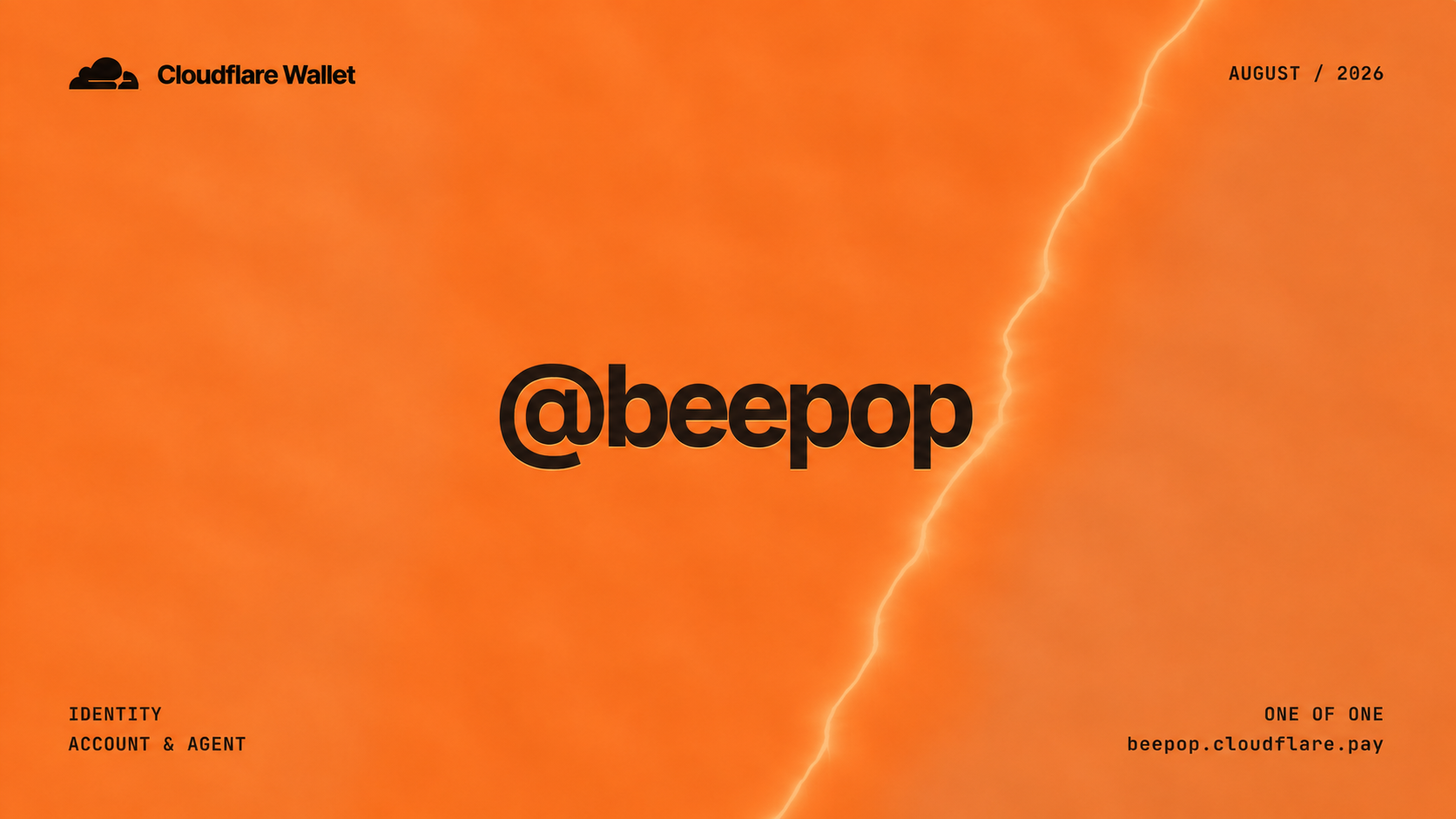
An organization could create a recognizable identity for a specific research assistant, purchasing bot, or software agent. A readable name would represent an underlying cryptographic identity that would otherwise be difficult for humans and merchants to recognize.
Using a readable identity would remain optional. Agents could choose not to disclose one, while merchants could decide whether identified agents receive different access or commercial terms from anonymous clients.
Cloudflare expects Wallets to complement technologies such as Web Bot Auth, which uses cryptographic key pairs to help automated clients declare and verify their identities.
However, a readable wallet handle, a cryptographic identity, and proof that an agent is authorized to represent a specific organization are not necessarily the same thing. The effectiveness of the system will depend on how clearly Cloudflare connects those layers and what information merchants can verify.
What AI Agents Could Buy
The most immediate use cases involve digital resources that can be delivered automatically.
Examples include:
- Individual API requests
- AI model inference
- Premium datasets
- MCP tool calls
- Research reports or paywalled content
- Image, audio, and video generation
- Small blocks of computing capacity
- Usage-based software features
- Automated data processing services
These services are well suited to machine-native payments because an agent may need to test several options before selecting one.
A monthly subscription, sales call, or lengthy account-registration process is inefficient when the first transaction may be worth only a few cents.
With an x402-compatible service, the payment requirement and proof of payment can travel with the web request. The agent does not necessarily need a pre-existing account, session, or API subscription with every seller.
The merchant, meanwhile, can charge directly for access to a resource rather than building a conventional checkout flow for every machine customer.
What Is Available Now?
Cloudflare Wallets was announced on August 4, 2026, but the complete wallet and payment product is not yet generally available.
Cloudflare currently allows users to claim a Wallet handle for their accounts. Broader capabilities are expected to arrive later, including the ability to configure Account and Virtual Wallets, store stablecoins, add or remove funds, delegate spending authority, define payment policies, and pay for digital resources.
That distinction matters. Cloudflare has introduced the architecture and opened the identity-handle layer, but developers should not assume that every wallet and payment feature described in the announcement is ready for production use.
Availability may also vary by geography and eligibility. Cloudflare says it plans to provide straightforward ways to move money into and out of wallets in supported regions, while eligible users may also be able to fund their wallets directly with stablecoins.
The Bigger Strategy Behind Cloudflare Wallets
Cloudflare is positioning itself on both sides of an emerging machine economy.
On the seller side, its payment infrastructure can help websites, APIs, datasets, and MCP tools charge agents for individual requests.
On the buyer side, Cloudflare Wallets is intended to give agents a controlled way to make those payments. The identity layer could give merchants additional context about who is making each request.
Combined, these components could support a headless transaction flow in which an agent discovers a service, receives machine-readable payment terms, checks its spending authority, completes the payment, and receives the resource without opening a conventional checkout page.
For Cloudflare, this is a natural extension of its existing position between Internet users and online services. If AI agent traffic increasingly becomes commercial traffic, Cloudflare wants to provide infrastructure that can identify the buyer, enforce payment rules, connect the transaction to a spending policy, and deliver the purchased resource through the same request flow.
Risks and Open Questions
The concept is promising, but several major questions remain.
Wallet policies will need to protect funds from compromised agents, malicious prompts, fraudulent merchants, accidental loops, and poorly defined tasks.
Organizations will also need audit trails explaining:
- What the agent purchased
- Which merchant received the payment
- How much was spent
- Which policy authorized the transaction
- What task the purchase was intended to support
- Whether the purchased resource was actually used
Stablecoin payments introduce additional regulatory, accounting, geographic, and operational considerations. Merchant adoption is another major factor. A wallet becomes much more valuable when a broad range of APIs, tools, and content providers accept the same payment standard.
There is also a tension between identity and privacy. Persistent agent identities could improve trust and reduce abuse, but users and organizations will need control over when those identities are disclosed and what merchants can infer from their transaction history.
The hardest problem may not be moving money. It may be proving intent.
Authentication can help establish which agent made a payment. Authorization policies can determine how much the agent is permitted to spend. But neither automatically proves that a purchase was genuinely necessary for the user’s task.
This creates three separate control problems:
- Authentication: Which agent is making the payment?
- Authorization: What is the agent allowed to buy and spend?
- Intent verification: Why is this purchase necessary for the task?
Cloudflare's proposed identity and policy controls address authentication and authorization more directly than intent verification.
Intent verification will still require better agent reasoning, transaction explanations, monitoring, and human review for sensitive purchases.
Final Thoughts
The most important idea behind Cloudflare Wallets is not that AI software can hold stablecoins. It is that humans and organizations may be able to delegate limited, auditable, and revocable purchasing authority to software without approving every small transaction.
That is the condition required for financial autonomy to become practical.
Without clear limits, people will hesitate to let an agent spend money. With enforceable budgets, approved-merchant lists, transaction caps, and exception handling, owners can allow agents to act independently while keeping the potential loss under control.
If Cloudflare Wallets and the wider x402 ecosystem gain adoption, agents could move beyond recommending tools and begin purchasing the exact APIs, data, content, and computing resources needed to complete a task. Merchants, meanwhile, could sell digital services directly to agents without forcing them through registration, subscription, and checkout workflows designed for people.
Although its broader payment capabilities are still forthcoming, Cloudflare Wallets points toward a future in which identity, permissions, payments, and service access converge within a machine-readable transaction.
For autonomous software, that could be the difference between assisting with a task and completing it.
FAQ
What are Cloudflare Wallets for AI agents?
Cloudflare Wallets is planned infrastructure for giving AI agents controlled access to funds. Humans or organizations would manage an Account Wallet, while individual agents would use Virtual Wallets governed by spending policies.
What is an x402 payment?
x402 is an open payment standard built around the HTTP 402 “Payment Required” status code. A service can return payment requirements in its response, allowing a client to pay programmatically and retry the request with proof of payment.
Can Cloudflare Wallets be used now?
Users can currently claim a Cloudflare Wallet handle. According to Cloudflare’s announcement, the broader wallet configuration, stablecoin storage, delegated spending, and agent payment capabilities are coming later.
How could Cloudflare prevent an AI agent from overspending?
Account owners are expected to be able to configure guardrails for Virtual Wallets, including total allowances, merchant allow lists, maximum transaction sizes, recurring spending limits, and human approval for exceptions.
What could AI agents purchase with Cloudflare Wallets?
Potential purchases include API calls, AI model inference, premium datasets, MCP tools, paywalled content, media generation, computing resources, and usage-based software features.
Sources
https://blog.cloudflare.com/wallets/
https://docs.cdp.coinbase.com/x402/welcome