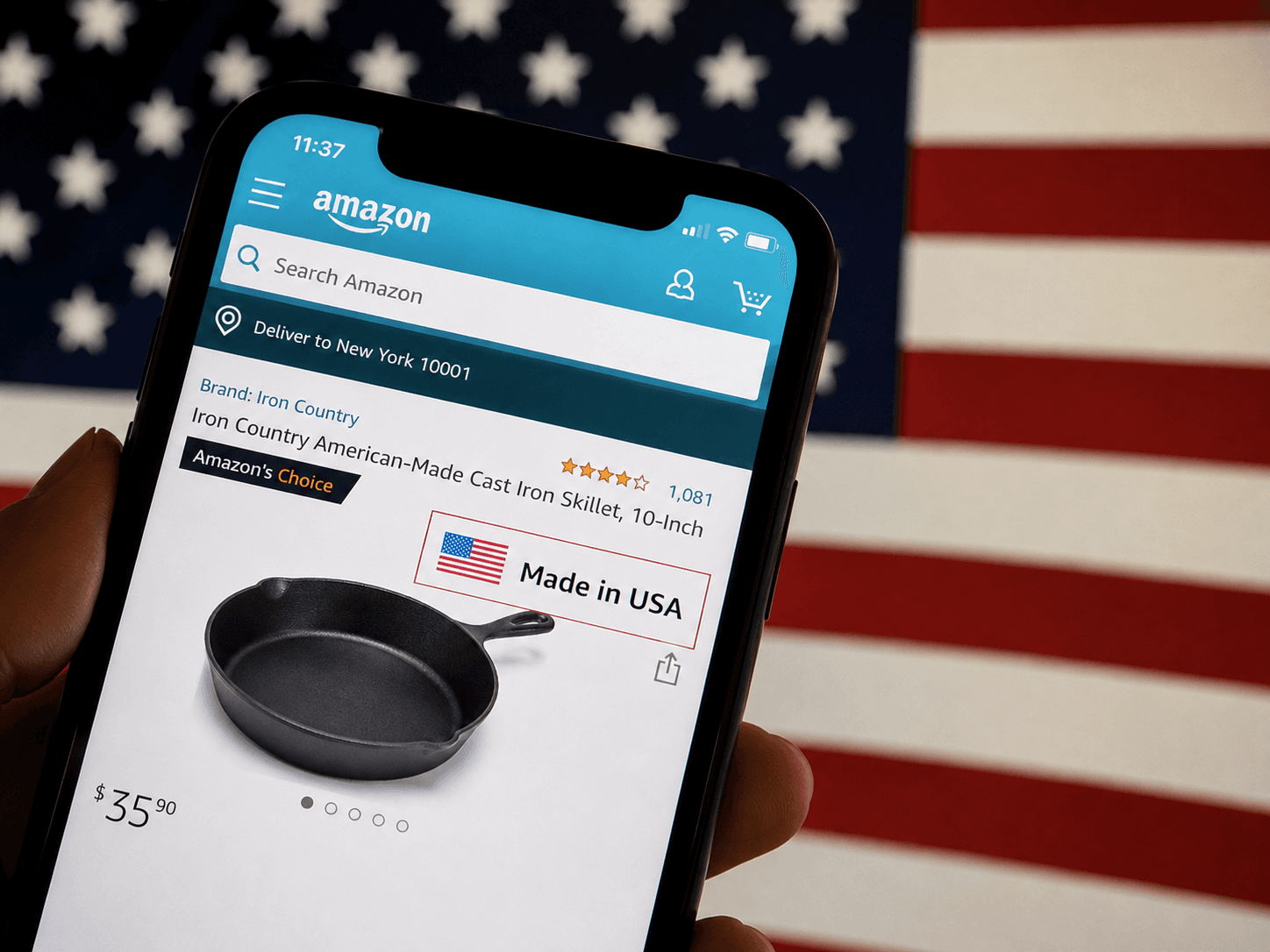
Amazon "Made in USA" claims are facing greater scrutiny following a new study examining how Amazon and Walmart handle potentially misleading country-of-origin information.
A July 2026 report from Columbia Law School’s Center for Law and the Economy reported that, in tests conducted by its authors, Amazon’s and Walmart’s AI shopping assistants identified apparent conflicts between "Made in USA" claims and product information indicating that certain items were imported.
However, the researchers argued that the assistants did not consistently surface these conflicts or help customers find products based on country of origin.
For Amazon sellers, the report highlights an important compliance risk: an AI shopping assistant may be able to recognize inconsistencies between a "Made in USA" claim and other information displayed on the same product page.
Why Amazon “Made in USA” Claims Are Under Scrutiny
The Columbia report, titled Made in America, Hidden by AI, examined Amazon’s Alexa for Shopping and Walmart’s Sparky shopping assistant.
Researchers tested whether the AI tools could recognize conflicts between American-made marketing and other product information.
According to the report, both shopping assistants identified listings where "Made in USA" appeared in a product title, description or comparison chart while another section described the product as imported.
Examples included apparel, work boots and bedding.
The researchers also reported that Amazon’s shopping assistant sometimes refused direct requests for products made in the United States while responding to similar questions phrased differently.
They interpreted this as evidence that the system may have access to product-origin information even when that information is not presented in response to a standard customer query.
The study was based on external tests of consumer-facing AI assistants. It does not prove that Amazon currently uses the same capabilities to enforce its marketplace policies or automatically remove misleading "Made in USA" claims.
How Amazon Responded
Amazon rejected the suggestion that it deliberately hides country-of-origin information.
The company said it displays product-origin information when manufacturers or third-party sellers provide the relevant data. Amazon also said it is working to improve how its shopping assistant answers questions about where products are made.
Amazon already uses automated systems and AI to scan attempted product-detail-page changes for signs of potential abuse.
According to Amazon's April 2026 Trustworthy Shopping Experience Report, its systems scan product-detail-page changes for signs of potential intellectual property infringement.
However, Amazon has not publicly explained whether similar systems are used specifically to identify or enforce misleading "Made in USA" claims.
What the FTC’s Made in USA Labeling Rule Requires
Under the FTC Made in USA rule, an unqualified claim generally requires a product to be “all or virtually all” made in the United States.
To support an unqualified "Made in USA" claim, a product generally must meet all of the following conditions:
- Final assembly or processing takes place in the United States.
- All significant processing occurs in the United States.
- All or virtually all components are made and sourced domestically.
The rule can apply to product listings, labels, packaging, images, advertising and other promotional materials.
A seller being located in the United States does not automatically make its products American-made. Storing imported products in an Amazon FBA warehouse also does not change their country of origin.
The complete impression created by a listing matters. American flags, maps and phrases such as "American quality" or "built in America" could potentially imply U.S. manufacture even when the exact phrase "Made in USA" is not used.
The FTC Has Warned Amazon About Seller Claims
On July 8, 2025, the FTC sent Amazon a warning letter concerning U.S.-origin claims made by third-party sellers.
The agency identified listings that used language such as "Made in the USA" and "100% USA Made," even though other information suggested that the products were imported.
The FTC asked Amazon to monitor and take corrective action against third-party sellers making false or misleading claims.
The letter also noted that Amazon's Seller Code of Conduct requires sellers to provide accurate information and prohibits misleading product details.
Regulatory activity has continued. In April 2026, the FTC announced a Made in USA enforcement sweep involving companies accused of making unsupported American-made claims.
Although those cases did not specifically target Amazon sellers, they show that the FTC continues to treat misleading origin claims as an enforcement priority.
What Amazon Sellers Should Do
Sellers should review all Amazon-facing materials where a "Made in USA" claim might appear.
Audit All Amazon-Facing Materials
Review:
- Product titles
- Bullet points
- Product descriptions
- A+ Content
- Product images
- Comparison charts
- Amazon Store pages
- Product videos
- Amazon Ads copy and creative assets
- Product packaging
A correct country-of-origin field may not be enough if unsupported American-made language appears elsewhere in the seller’s Amazon-facing materials.
Information can also become inconsistent when listings are edited by multiple contributors, copied from suppliers or combined through catalog changes.
When creating or localizing Amazon listing visuals with tools such as BeePOP, sellers should verify that all country-of-origin wording and imagery remain consistent with their documented manufacturing information.
Look for Implied Claims
Review patriotic images and phrases that could give customers the impression that a product was manufactured in the United States.
Consider how a reasonable customer would interpret the complete listing rather than evaluating individual words in isolation.
Maintain Supporting Evidence
Sellers making "Made in USA" claims should retain documentation such as:
- Bills of materials
- Supplier declarations
- Component-origin records
- Manufacturing documents
- Factory information
- Assembly records
- Purchase invoices
Supplier assurances should be verified. Sellers remain responsible for claims appearing in their listings and advertising.
Use Qualified Claims When Necessary
A product containing meaningful imported components may not qualify for an unqualified "Made in USA" claim.
Depending on the facts, a more specific statement may be appropriate:
- "Assembled in the USA with imported components"
- "Designed in the USA"
- "Made in the USA from domestic and imported materials"
Qualified claims must also be truthful and supported by evidence.
Keep Product Information Consistent
The title, description, images, packaging and country-of-origin field should provide consistent information.
Conflicting information can increase the risk of customer complaints, competitor reports, platform review, listing restrictions or regulatory scrutiny.
What This Means for Amazon Sellers
Amazon has not announced a new enforcement program in response to the Columbia study.
Nevertheless, Amazon "Made in USA" claims are now receiving attention from researchers, regulators and customers. AI shopping assistants may add another layer of scrutiny by identifying contradictions within product listings.
International sellers should be especially cautious when using U.S.-focused marketing and should ensure that every origin claim is supported by reliable manufacturing and sourcing records.
The safest approach is to make only claims that can be documented and to keep country-of-origin information consistent across all Amazon-facing materials.
FAQ
Can imported products use “Made in USA” in an Amazon listing?
Generally, an unqualified claim should not be used unless the product meets the FTC’s "all or virtually all" standard. A truthful qualified claim may be more appropriate when imported components are involved.
Does Amazon FBA change a product’s country of origin?
No. Shipping or storing a product through a U.S. Amazon fulfillment center does not change where it was manufactured.
Can Amazon take action against misleading origin claims?
Misleading product information may violate Amazon's Seller Code of Conduct. Amazon may correct, restrict or remove a listing and could take further action against the seller account.
Sources
- Columbia Law School Center for Law and the Economy, Made in America, Hidden by AI, July 2026.
- Federal Trade Commission, Letter Re: Misleading Made in USA Representations by Third-Party Sellers, July 8, 2025.
- Federal Trade Commission, Federal Trade Commission Warns Companies to Comply with “Made in USA” Requirements, July 8, 2025.
- Federal Trade Commission, FTC Announces “Made in the USA” Sweep, Including Three Law Enforcement Actions to Protect American Consumers and Businesses, April 14, 2026.
- Amazon, Trustworthy Shopping Experience Report, April 2026.
- Tom’s Guide, Shopping on Amazon or Walmart? Why You Shouldn’t Rely on Their AI Assistants Just Yet, July 2026.