Amazon is expanding an import-record requirement that previously focused mainly on shipments sent directly to fulfilment centres in France.
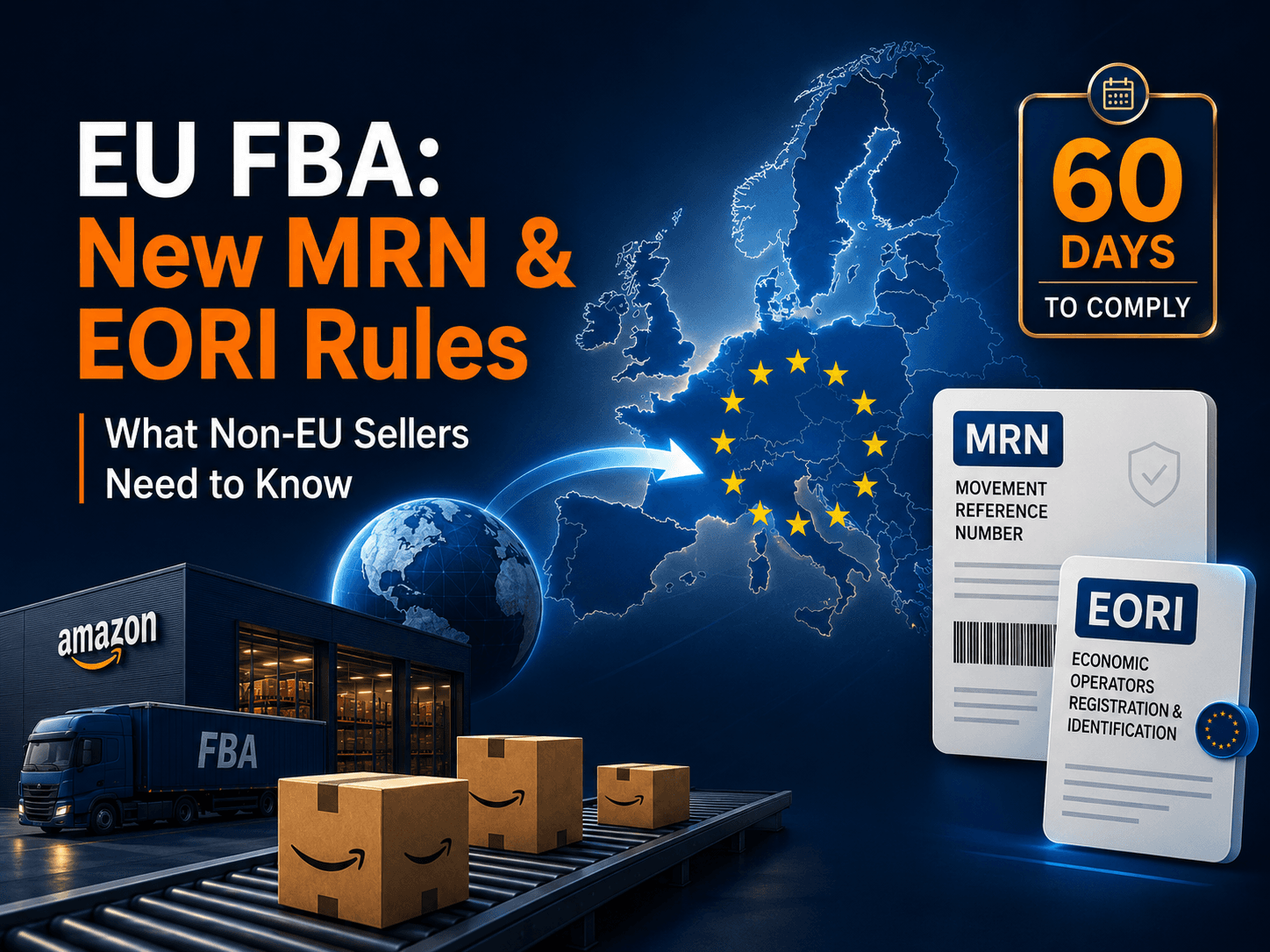
From September 1, 2026, companies registered outside the European Union and enrolled in Pan-European FBA must provide valid MRN and EORI information for applicable shipments received at Amazon fulfilment centres across the EU.
The requirement also applies when a non-EU company sends imported goods directly to an Amazon fulfilment centre in France, even if the seller is not enrolled in Pan-European FBA.
Amazon gives sellers 60 days to provide the required import details. If one or more applicable shipments still have missing or invalid import details after that period, Amazon will prevent the seller from creating new shipments to EU fulfilment centres.
What Is Actually Changing?
Amazon already collects customs information for certain goods imported from outside the EU and stored in France.
The September 1 update expands the scope in two ways:

The change reflects how Pan-European FBA works. Inventory received in one EU country may later be moved by Amazon to another country, including France.
As a result, Amazon is asking eligible Pan-European FBA sellers to provide import records for shipments received throughout its EU fulfilment network—not only shipments originally delivered to France.
Which Sellers Are Affected?
The requirement applies when all the following conditions are met:
- The company is registered outside the EU;
- The products are shipped from outside the EU; and
- The products are delivered directly to a French fulfilment centre or received at another EU fulfilment centre while Pan-European FBA is enabled.
This may include companies registered in China, the United States, Canada, Australia and the United Kingdom.
UK companies are treated as non-EU businesses for this requirement.
Companies registered inside the EU are generally exempt. A non-EU company may also be exempt when the goods were purchased within the EU rather than imported from outside the EU.
In that situation, the seller should retain valid commercial invoices. Amazon may request them to confirm that the goods were purchased locally.
What Information Must Be Provided?
Amazon requires two pieces of customs information:

An MRN normally contains 18 characters and is generated in connection with a customs declaration or movement.
An EORI is a unique customs identification number assigned to an economic operator or another eligible person. It is different from a VAT number.
Amazon allows a seller to provide the customs broker’s EORI when that broker used its own EORI to declare the goods. The information entered in Seller Central should therefore match the underlying customs declaration.
Which Country’s MRN and EORI Should Be Used?
Amazon’s notice states that sellers must provide the MRN and EORI corresponding to the country where the goods were first customs-cleared into the EU—that is, the country or region where customs clearance was completed.
This is not necessarily the country where the final Amazon fulfilment centre is located.
For example, a US seller ships products from China to an Amazon fulfilment centre in Germany and has Pan-European FBA enabled.
If the products first enter the EU and clear customs in Germany, the seller should provide the MRN and EORI associated with that German customs clearance.
Amazon may later move some of the inventory to France, but that does not change where the original EU customs clearance occurred.
Three Common Seller Scenarios
Scenario 1: China to Germany under Pan-European FBA
A Chinese company sends inventory from China to an Amazon fulfilment centre in Germany.
The goods clear customs in Germany, and the seller is enrolled in Pan-European FBA.
The shipment falls within the expanded requirement. The seller should obtain the MRN and EORI used during the German customs clearance process.
Scenario 2: United Kingdom to France without Pan-European FBA
A UK company sends imported goods directly to an Amazon fulfilment centre in France.
The seller is not enrolled in Pan-European FBA.
The requirement still applies because the company is registered outside the EU and the shipment is sent directly to France.
Scenario 3: A US Company Purchases Inventory in the EU
A US company purchases goods from an EU supplier and sends them to an Amazon fulfilment centre in Germany.
Because the goods were purchased within the EU rather than imported by the seller from outside the EU, the company may qualify for the local-purchase exemption.
The seller should keep the final commercial invoices in case Amazon requests supporting evidence.
The Real Consequence: Existing Inventory Can Sell, but Replenishment Stops
For applicable shipments received from September 1, 2026, sellers have 60 days to complete the required MRN and EORI information.
If one or more shipments still have missing or invalid import details after the deadline, Amazon will prevent the seller from creating new shipments to EU fulfilment centres.
However:
- Existing FBA inventory can continue to be sold;
- Amazon can continue fulfilling customer orders;
- Shipments already in transit can still be received;
- The restriction will be removed automatically after the missing information is completed and accepted.
The immediate consequence is therefore not a listing suspension. It is the loss of the seller’s ability to replenish EU inventory.
In short: Amazon does not immediately stop the sale. It stops the next shipment.
How Sellers Should Prepare
1. Identify the shipments in scope
Review:
- Shipments sent directly to France;
- EU shipments connected to Pan-European FBA;
- Shipments imported by a customs broker or third-party logistics provider;
- Shipments currently marked as having incomplete import details.
2. Contact the customs provider
Ask the freight forwarder or customs broker to provide:
- The final customs declaration;
- The MRN;
- The EORI used during clearance;
- The name of the importer of record;
- The country where EU customs clearance was completed.
3. Match customs records to Amazon shipments
The MRN should be connected to the relevant Amazon shipment ID.
This step can become difficult when one logistics provider handles a consolidated customs declaration covering several Amazon shipments. Sellers should retain a record showing which shipment IDs were included in each declaration.
4. Check the Status in Seller Central
Import information can be reviewed through the Manage Shipments page.
Amazon currently requires sellers to enter the details at shipment level. Bulk MRN uploads are not available, according to the August 11 announcement.
5. Add Import Details to the Shipment Workflow
MRN and EORI collection should be completed shortly after customs clearance rather than close to the end of the 60-day period.
A basic internal record can include:
- Amazon shipment ID;
- Customs-clearance date;
- First EU country of entry;
- MRN;
- EORI used;
- Customs broker;
- Seller Central submission status.
FAQ
1. Does Every Affected Seller Have to Submit All Information by September 1?
Not necessarily.
September 1, 2026 is the effective date for the expanded requirement. Amazon states that sellers have 60 days from the relevant receipt date to provide the import information.
The exact status of each shipment should be checked in Seller Central.
2. Do Direct-to-France Shipments Require Pan-European FBA?
No.
A non-EU company shipping imported goods directly to a French fulfilment centre can be subject to the requirement even when Pan-European FBA is not enabled.
3. Can a Seller Provide Its Customs Broker’s EORI?
Yes, if the broker used its own EORI when declaring the goods.
The EORI submitted to Amazon should match the customs arrangement and supporting declaration.
4. What If One Declaration Covers Several Amazon Shipments?
Amazon allows the same MRN to be submitted for multiple shipments when those shipments were legitimately covered by the same customs declaration.
Similarly, if one Amazon shipment contains goods covered by several declarations, multiple MRNs can be entered for that shipment. Sellers should keep documentation explaining the relationship between the declarations and shipment IDs.
What This Means Operationally
Most established importers already receive MRN and EORI information during customs clearance. The new challenge is making sure those records can be matched to the correct Amazon shipment and submitted within Amazon’s deadline.
In many businesses, the customs broker holds the declaration, the logistics team tracks the freight, and the Amazon operations team manages Seller Central. When these records are stored separately, identifying the correct MRN several weeks later can become difficult.
The practical improvement is therefore not simply to “collect more compliance documents.” It is to connect customs clearance with the completion of each Amazon shipment record.
For non-EU sellers using Pan-European FBA, a shipment should no longer be treated as operationally complete when the products reach the fulfilment centre. It should be considered complete only after the customs information has also been matched and recorded.