Artificial intelligence is already widely used by Amazon sellers, but most adoption has focused on relatively simple tasks.
Sellers use generative AI to write listings, improve product titles, research keywords, translate content, and create advertising materials. These applications save time, yet they rarely solve the more difficult operational problems behind an Amazon business.
A chatbot can rewrite a product description. To continuously diagnose sales changes, monitor advertising performance, or act on store data, however, AI needs access to business systems, operational context, and defined workflows.
That distinction is driving the next stage of AI for Amazon sellers: the shift from standalone tools to operational AI agents.
AI Adoption Is High, but Automation Remains Limited
Amazon Global Selling’s 2026 white paper reports that more than 98% of surveyed Chinese cross-border sellers use AI tools in their daily operations.
However, that figure should not be interpreted as evidence that 98% of all Amazon businesses have automated their operations. The survey refers specifically to participating Chinese sellers, and “using AI” may mean anything from generating copy to building an advanced automated workflow.
Amazon’s analysis suggests that only a smaller group has moved beyond individual tools and started connecting AI with business systems, data, and APIs.
This creates three broad levels of adoption:
- Content assistance: AI produces listings, translations, images, and marketing copy. Product-visualization tools are one example of this first layer, helping sellers automate listing images and other e-commerce assets before AI expands further into analytics and operations.
- Decision support: AI analyzes reports, identifies patterns, and recommends actions.
- Agent-based operations: AI monitors data continuously and performs defined tasks under established rules.
Agent-based operations remain less common than content assistance and decision support.
Where AI Agents Can Create Real Value
The strongest use cases for AI in Amazon operations are usually repetitive, data-heavy tasks rather than high-level business strategy.
Advertising analysis
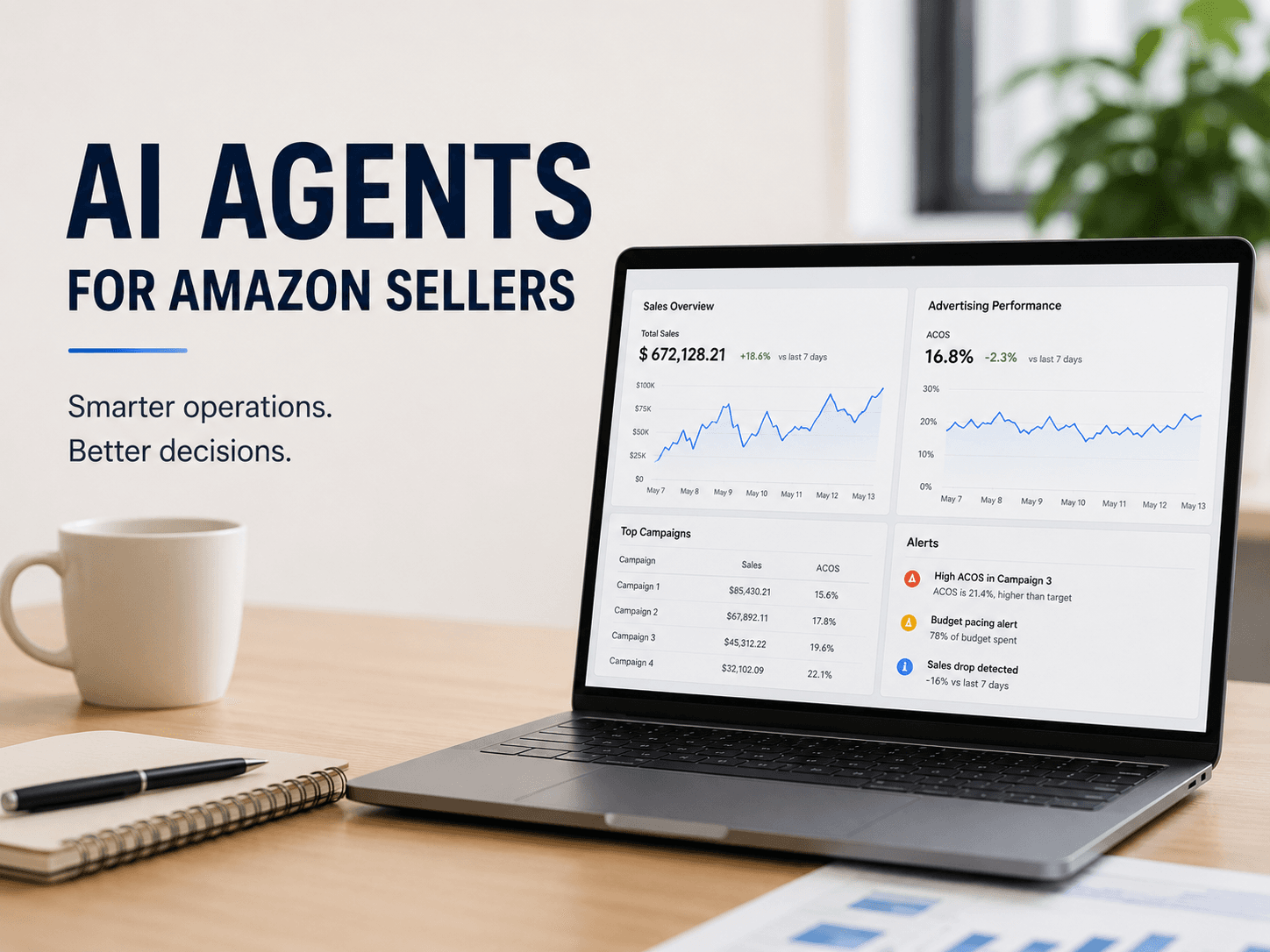
Amazon advertising accounts can contain large numbers of campaigns, targets, and search terms. Reviewing them manually becomes increasingly difficult as the account grows.
An AI agent can help identify:
- Search terms generating spend without sales
- Campaigns with rapidly rising ACOS
- Products receiving traffic but producing weak conversion
- Budgets concentrated in low-performing campaigns
- Unusual changes in impressions, clicks, or orders
The value is not simply that AI can recognize a poor-performing keyword. It is that the system can monitor performance consistently and bring exceptions to the seller’s attention sooner.
Sales anomaly detection
A sudden decline in sales may be caused by advertising changes, inventory shortages, price movements, lost Buy Box eligibility, competitor activity, or listing problems.
AI cannot always determine the correct cause automatically. It can, however, compare several data points and reduce the number of possibilities an operator needs to investigate.
This turns AI into a diagnostic assistant rather than an unquestioned decision-maker.
Automated reporting
Weekly reporting often requires sellers to export spreadsheets, compare periods, calculate changes, and write summaries.
AI agents can automate much of this preparation. A useful report could highlight the largest performance changes, identify possible explanations, and list issues requiring human review.
That saves time without giving the system authority to make irreversible business decisions.
Routine operational monitoring
AI can also monitor inventory levels, advertising limits, listing performance, account-health notifications, and other recurring signals.
Amazon has been introducing agentic capabilities into Seller Assistant, including the ability to reason, plan, and—with seller permission—assist with certain actions. This demonstrates that agent-based operations are becoming part of Amazon’s own seller-tool strategy, not merely a trend among third-party software providers.
Early Seller Results Are Promising—but Need Context
Amazon’s 2026 analysis highlights several businesses that have adopted AI more deeply.
Beauty brand MelodySusie reportedly connected an AI agent with the Amazon Ads API. The system supported campaign launches, optimization, monitoring, and risk controls. According to the case study, more than 90% of operational execution was automated, ACOS fell to roughly one-third of the cited industry level, and conversion increased by nearly 40%.
Other examples include small teams using AI to manage workloads that previously required substantially more employees.
These results are notable, but they should be treated as case studies rather than universal benchmarks.
A seller cannot assume that installing an AI agent will automatically produce similar improvements. Results will depend on factors such as:
- Existing campaign quality
- Product competitiveness
- Data accuracy
- Marketplace conditions
- The quality of the automation rules
- The operator’s ability to evaluate AI recommendations
The most successful examples may also be more likely to appear in industry reports than unsuccessful deployments.
AI Agents Should Not Operate Without Boundaries
The growth of AI for Amazon sellers introduces several operational risks.
Data access
An agent may need access to advertising, sales, inventory, and account information. Sellers should understand exactly which permissions are being granted and whether the provider stores or shares that data.
Incorrect recommendations
AI can misinterpret correlations as causes. For example, it may connect a sales decline with an advertising change even when the actual problem is inventory availability or competitor pricing.
Recommendations should therefore be supported by visible data rather than presented as unexplained conclusions.
Excessive automation
Automatically reducing bids or adding negative keywords may improve short-term efficiency while limiting longer-term product discovery.
Actions affecting campaign structure, pricing, inventory, or account settings should generally require human approval until the system has demonstrated consistent reliability.
Platform dependency
Amazon policies, advertising systems, and marketplace conditions change regularly. An agent trained around outdated rules can produce recommendations that are technically logical but operationally unsuitable.
AI systems need ongoing monitoring and updating, just like the businesses they support.
A Practical Adoption Framework
Sellers do not need to automate the entire business at once.
A lower-risk approach is to introduce AI in stages.
Begin with read-only activities such as reporting, performance summaries, and anomaly alerts. These tasks allow the seller to evaluate the quality of the system without permitting it to change account settings.
The next stage can involve recommendations for keywords, bids, and budget allocation. Operators can compare those suggestions with their own decisions before approving any changes.
Only after the system has produced reliable results should sellers consider limited automated actions. Even then, spending limits, approval requirements, change logs, and rollback procedures should remain in place.
The goal is not to remove people from Amazon operations. It is to reduce repetitive analysis so that operators can focus on product strategy, customer needs, and business growth.
The Future of AI for Amazon Sellers
AI agents are unlikely to replace experienced Amazon operators in the immediate future.
What they can replace is part of the manual work surrounding those operators: downloading reports, checking dashboards, finding unusual changes, and preparing routine summaries.
This may allow smaller teams to manage more products and marketplaces. It could also change the skills Amazon businesses value. Operators may spend less time manipulating spreadsheets and more time defining rules, reviewing recommendations, and deciding when automation should—or should not—take action.
The competitive advantage will not come from simply having access to AI. It will come from building a reliable system in which business data, automation, and human judgment work together.
Related tool: Explore how BeePOP helps Amazon sellers automate product visualization for listing images and other e-commerce assets.
FAQ
What is AI for Amazon sellers?
AI for Amazon sellers refers to software that assists with tasks such as listing creation, keyword research, advertising analysis, reporting, inventory monitoring, and operational decision-making.
What is the difference between an AI tool and an AI agent?
An AI tool normally completes an individual task after receiving a prompt. An AI agent can monitor data, follow a multi-step process, and recommend or perform actions based on predefined rules.
Can AI agents manage Amazon PPC campaigns?
AI agents can analyze search terms, bids, budgets, conversions, and ACOS. They may also recommend or automate campaign changes. Sellers should establish spending limits and human-approval rules before allowing automated execution.
What should sellers automate first?
The safest starting points are read-only reporting, anomaly alerts, and performance summaries. Automated bidding, keyword changes, and budget allocation should be introduced gradually.
Sources
- Amazon Global Selling, Amazon Global Selling Releases Five Trends in AI-Driven Cross-Border E-commerce Globalization, June 11, 2026.
- Amazon Global Selling, AI Reshapes Global Expansion: From Tool Adoption to Systemic Transformation, July 27, 2026.
- Amazon Global Selling, Next-Generation Cross-Border Commerce and Amazon’s 2026 Strategic Priorities.
- AMZ123 original article, published August 19, 2026.