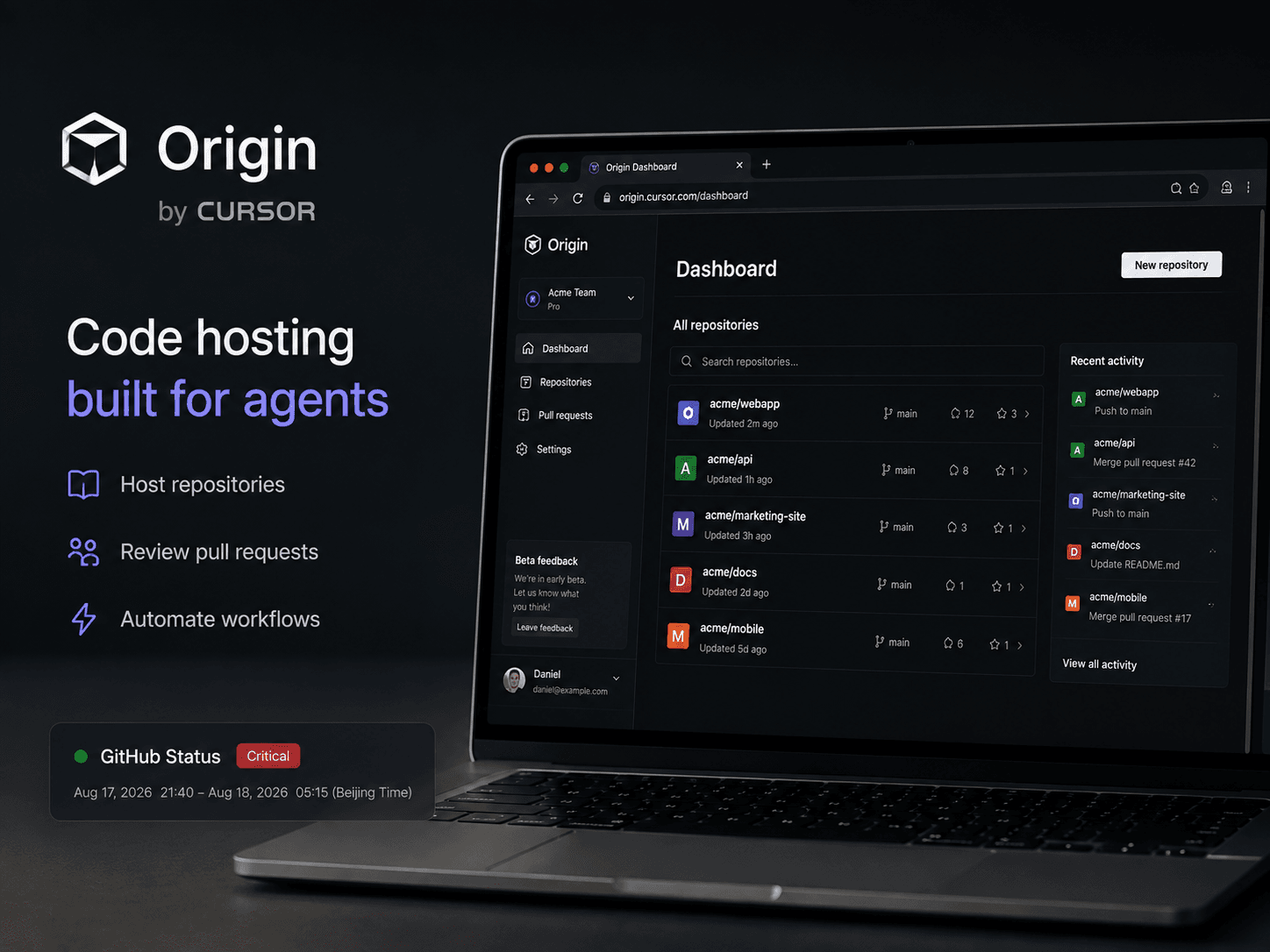
Origin isn't a "GitHub killer"—but it reveals Cursor's bigger ambition
On August 17, 2026, GitHub suffered a major service disruption.
According to GitHub’s official status records, the incident began at approximately 9:40 p.m. Beijing time on August 17 and was not marked as resolved until around 5:15 a.m. the following morning.
GitHub classified the incident as “critical.” At one point, around 20% of web and API requests were failing, while downloads of repository archives and raw files saw error rates of roughly 50%.
A wide range of services were affected, including Pull Requests, Actions, Git Operations, Issues, Webhooks, Pages, and Copilot. GitHub said it would publish a more detailed root-cause analysis later.
On the same day, Cursor announced that Origin, its own code-hosting platform, had begun rolling out in early beta.
There is no evidence that Cursor timed the launch in response to GitHub’s outage. The two events simply happened to fall on the same date.
Still, the coincidence gave Origin a remarkably dramatic entrance.
While developers were struggling to browse code, submit pull requests, and run workflows on GitHub, Cursor was announcing that it could now host their code as well.
Cursor No Longer Wants to Just Help You Write Code
According to Cursor’s August 17 announcement, Origin is currently in early beta and is being rolled out gradually to users on paid plans.
Its core capabilities include:
- Creating and hosting Git repositories
- Cloning, pushing, and pulling with standard Git commands
- Browsing and searching code online
- Creating, reviewing, and merging pull requests
- Synchronizing existing GitHub repositories with Origin
- Allowing Cursor’s cloud agents to modify code, create branches, and open pull requests
- Connecting repositories to Vercel, Depot, and Buildkite
In other words, Cursor is no longer just an AI editor operating outside the repository.
Code, pull requests, automated tasks, and AI agents can now exist within the same product ecosystem.
Origin was not revealed for the first time this week. Cursor had already previewed the product at its Compile conference in June 2026, describing it as a new Git platform. At that point, it had not yet been released.
The real development this time is that Origin has entered a usable early-beta stage.
What Can Origin Actually Do?
When developers create a new Origin repository, the code is hosted directly on Cursor’s infrastructure.
They can continue using familiar Git commands without changing their basic version-control habits. Once code has been pushed to Origin, developers can browse files, inspect commit histories, search the codebase, and create pull requests from branches.
Cursor’s cloud agents can connect directly to these repositories. They can clone a project, create a branch, modify files, commit changes, and open a pull request.
Automations can also be triggered by events such as a code push, the creation of a pull request, or an update to an existing pull request.
But Cursor clearly understands that most development teams are not going to move all their code away from GitHub overnight.
That is why Origin offers a more gradual migration path: GitHub repository mirroring.
After connecting a GitHub repository, Origin can synchronize its Git history, branches, tags, source code, and pull requests. Reviews and comments made through Cursor can also be synchronized back to GitHub.
This does not mean Origin immediately takes control of the repository.
For mirrored projects, GitHub remains the source of truth. Code pushed through Origin continues to be forwarded to GitHub. GitHub Issues, Actions workflows, and secrets are not copied into Origin.
Only after the user explicitly disconnects the GitHub repository does Origin become the project’s independent hosting platform.
Cursor’s current strategy therefore appears to be less about forcing developers to migrate and more about bringing GitHub repositories into Cursor first—then gradually moving more of the development workflow onto its platform.
Why Does Cursor Need to Host Code?
On the surface, Origin may look like Cursor simply added a GitHub-style repository page.
Strategically, however, it may address one of the biggest limitations facing AI coding tools: an autonomous coding agent needs more than an editor.
An agent capable of completing real software-development tasks needs to understand the full codebase, create branches, access an execution environment, modify files, commit code, open pull requests, read review comments, fix problems, and eventually move those changes toward deployment.
When code hosting, permissions, pull requests, continuous integration, and AI agents all belong to separate platforms, the agent must constantly cross account, API, and authorization boundaries.
Hosting the repository inside Cursor shortens that chain:
A task enters Cursor. An agent reads the code, creates a branch, implements the change, opens a pull request, runs the necessary checks, and responds to review feedback.
Origin therefore expands Cursor’s role from assisting with code generation to coordinating more of the workflow through which code is produced.
Will Origin Replace GitHub?
Not anytime soon.
First, Origin is still in early beta and is being rolled out gradually to users on paid plans.
Cursor also warns that eligible customers may not see Origin immediately because the release is being staged.
Second, Origin currently focuses on foundational features such as repository hosting, code browsing, search, and pull requests.
GitHub Issues, Actions workflows, and secrets are not transferred when a repository is mirrored. Cursor’s officially listed third-party integrations are also currently concentrated around Vercel, Depot, and Buildkite.
Compared with GitHub’s years of ecosystem development, open-source participation, community relationships, and third-party integrations, Origin is still at a very early stage.
It would therefore be more accurate to describe Origin not as a mature GitHub replacement, but as a Git-hosting platform redesigned around AI agents.
Its first target may not be the entire open-source community. Instead, Cursor is likely to appeal most strongly to teams already relying heavily on Cursor, cloud agents, and automated development workflows.
For these teams, Origin’s value proposition may not be cheaper code hosting. It may be the ability to give agents more direct access to code—and allow them to complete a larger portion of the development workflow.
The Real Competition Is Just Beginning
Until recently, competition between AI coding tools largely centered on one question:
Which product generates better code?
As agents become more capable, the competition is moving to a different level:
Which company can control the complete loop from task and code to pull request, testing, review, and deployment?
If an AI coding company focuses only on code generation, its role may remain largely at the interface layer.
A company that also controls the repository, execution environment, review process, automation system, and developer interface has an opportunity to become part of the team’s core development infrastructure.
The arrival of Origin suggests that Cursor no longer wants to remain a smarter code editor.
It is entering GitHub’s territory—but it is not necessarily trying to compete according to GitHub’s existing rules.
GitHub grew into a platform around repositories, developer collaboration, open-source communities, and increasingly AI-assisted development. Cursor appears to be approaching the problem from the opposite direction: starting with AI coding agents and expanding outward into repository infrastructure.
That is what makes Origin significant.
It is far too early to call it a “GitHub killer.” But it raises a question GitHub and every other development platform will eventually have to confront:
When a growing share of code is no longer written line by line by humans, but continuously generated, tested, reviewed, and submitted by agents, should code-hosting platforms still be designed primarily around people—or should they be designed around people and agents together?
With Origin, Cursor has given us its answer.
FAQ
What is Cursor Origin?
Origin is Cursor’s code-hosting platform. It allows developers to host Git repositories, browse and search code, manage pull requests, run automations, and let Cursor’s cloud agents work directly with repositories.
Who can access Origin?
Cursor’s official announcement says Origin is being rolled out gradually to users on paid plans. Because the rollout is staged, eligible users may not receive access immediately.
Does Origin replace GitHub?
Not necessarily. Origin can mirror an existing GitHub repository while GitHub remains the source of truth. Developers can continue using GitHub while accessing the repository and managing parts of the workflow through Cursor.
Origin only becomes the independent host after the GitHub connection is explicitly removed.
What information can Origin synchronize from GitHub?
According to Cursor’s documentation, Origin can synchronize:
- Git history
- Branches
- Tags
- Repository code
- Pull requests
- Pull-request comments and reviews
GitHub Issues, Actions workflows, and secrets are not copied to Origin.
Did Cursor launch Origin because GitHub went down?
There is no evidence of that.
Cursor announced Origin on August 17, 2026—the same date as GitHub’s critical service incident—but neither company has indicated that the two events were connected. Their appearance in the article is a timely comparison, not a claim of causation.