DeepSeek-V4.1-Flash Is Really About Efficient Long-Context AI
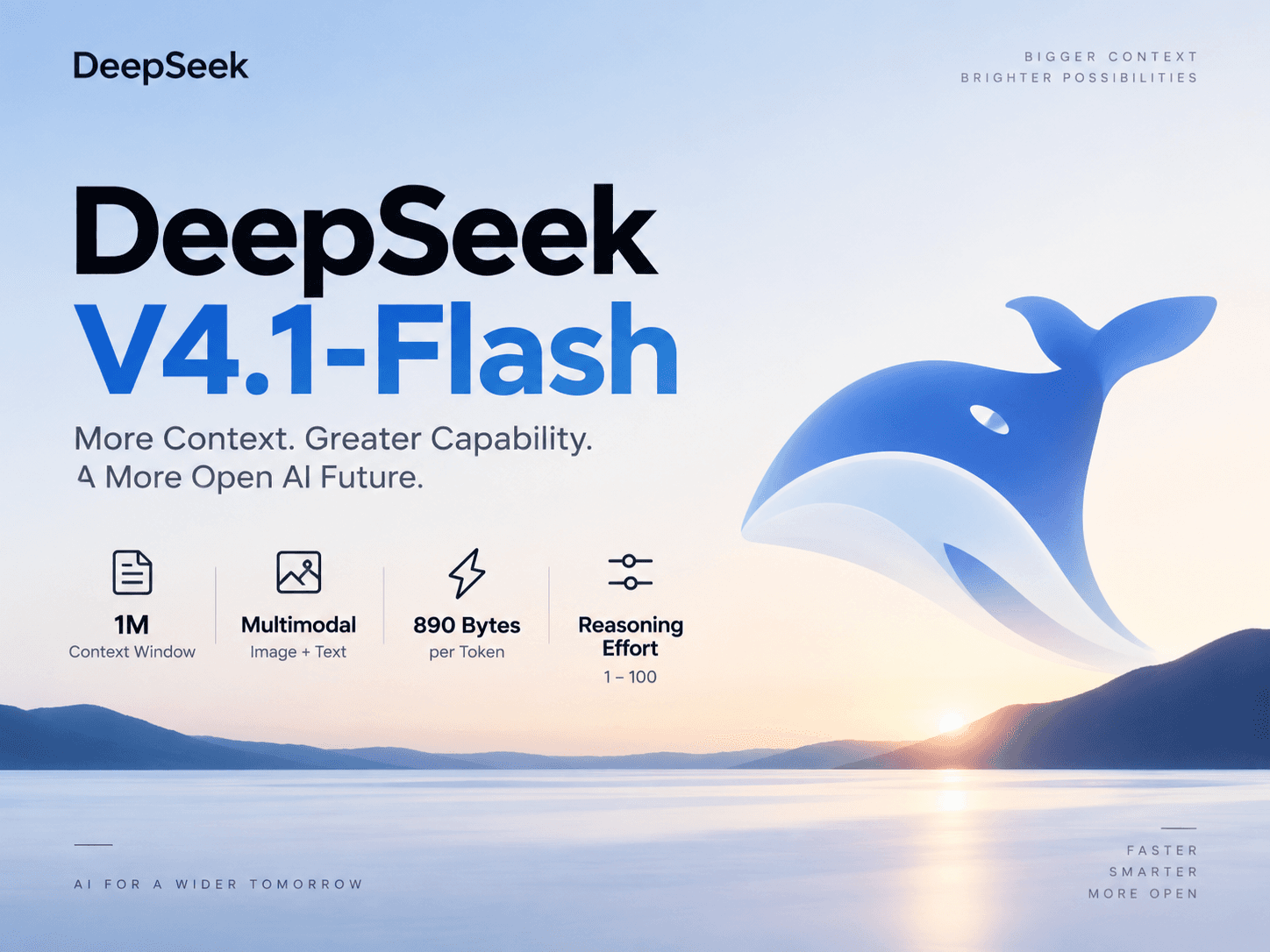
The most eye-catching number in DeepSeek-V4.1-Flash is its 1M-token context window.
But the more important number may be 890 bytes per token.
That is the global KV cache footprint DeepSeek reports for the new model—roughly one-quarter of DeepSeek-V4-Flash. The significance is straightforward: giving AI agents more working memory is useful only if that memory can be served efficiently.
Released on September 10, 2026, DeepSeek-V4.1-Flash combines a larger 552B-parameter MoE backbone with native multimodal input, stronger agent performance, finer reasoning control, and a redesigned memory and attention architecture.
The result is not just a larger model. It is a model built around a specific infrastructure problem:
how to make long-running, context-heavy AI agents cheaper and more scalable.
What’s New in DeepSeek-V4.1-Flash?
The release introduces five major changes:
- native image and text input
- a 1M-token context window
- a new Causal Encoder-Decoder architecture
- Compressed Sparse Attention 2 with major KV cache reduction
- continuous reasoning effort from 1 to 100
DeepSeek also reports substantial gains on coding, security, and automation benchmarks.
Native Multimodal Support
DeepSeek-V4.1-Flash supports:
Image + Text → Text
The model uses a vision encoder called DeepSeek-ViT, with visual embeddings integrated into the language-model training pipeline rather than treated as a separate late-stage add-on.
That expands the model beyond text-only reasoning into tasks involving:
- screenshots
- charts
- documents
- browser interfaces
- visual debugging
- product images
DeepSeek had already experimented with multimodal capabilities in DeepSeek-V4-Flash-Vision-Exp. V4.1-Flash brings that capability into the new architecture itself.
How DeepSeek Makes 1M Context More Practical
DeepSeek-V4.1-Flash supports up to 1,000,000 tokens, but the more interesting part is how it manages that context.
The model uses a new Causal Encoder-Decoder architecture, or CED, with:
20 encoder layers + 20 decoder layers
Instead of letting every decoder layer maintain a large independent global KV cache, the decoder derives KV states from the encoder's final hidden representation.
DeepSeek pairs this with Compressed Sparse Attention 2, or CSA2.
CSA2 allows layers to operate in Full, Reindex, or Reuse modes, sharing KV states and reusing sparse attention indices instead of repeatedly rebuilding the same information.
The practical result is a global KV cache footprint of:
890 bytes per token
According to DeepSeek, that is about one-quarter of V4-Flash.
This matters because long-context AI systems quickly become memory-bound.
Reducing KV cache usage can help with:
- larger context windows
- more concurrent sessions
- lower GPU memory pressure
- better throughput
- lower inference cost
For long-running agents, these infrastructure gains may be more important than a modest increase in benchmark accuracy.
Bigger Model, Sparse Activation
DeepSeek-V4.1-Flash has a 552B-parameter backbone, but it does not activate all of those parameters for every token.
DeepSeek reports approximately:
- 8B activated parameters during prefill
- 16B activated parameters during decoding
This distinction is important in Mixture-of-Experts systems.
Total parameter count describes model capacity. Activated parameter count is more closely tied to actual inference compute.
That helps explain how DeepSeek can scale model capacity while still targeting efficient serving.
Reasoning Effort Is Now Adjustable From 1 to 100
DeepSeek-V4.1-Flash introduces continuous control over reasoning through:
reasoning_effort = 1–100
DeepSeek describes this as a way to trade inference cost against accuracy.
Earlier DeepSeek V4 API models used three reasoning levels:
- low
- high
- max
V4.1-Flash offers a much finer control surface.
That could be useful in production systems where different tasks require different reasoning budgets.
Simple extraction or classification tasks may not need expensive reasoning, while coding, debugging, and multi-step agent work may benefit from much higher effort.
Agent and Coding Performance Improved Sharply
DeepSeek's benchmark results show some of the largest gains in agentic workloads.
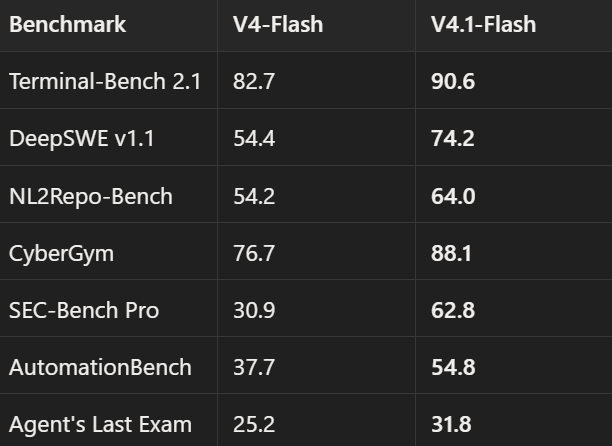
The jump on DeepSWE is especially notable:
54.4 → 74.2
SEC-Bench Pro nearly doubles:
30.9 → 62.8
These results suggest V4.1-Flash is particularly optimized for tasks that require the model to interact with tools, modify code, inspect environments, and complete multi-step workflows.
DeepSeek-V4.1-Flash Does Not Win Every Benchmark
V4.1-Flash is not simply DeepSeek's highest-scoring model across all categories.
DeepSeek reports:
- GPQA Diamond: 90.9
- HLE: 36.8
- MathArena Apex: 65.6
On some pure reasoning benchmarks, V4.1-Flash does not surpass DeepSeek-V4-Pro.
That helps clarify its positioning.
The model appears optimized around:
agent capability + long context + multimodality + serving efficiency
rather than maximizing every standalone reasoning benchmark.
DeepSeek-V4.1-Flash vs DeepSeek-V4-Flash
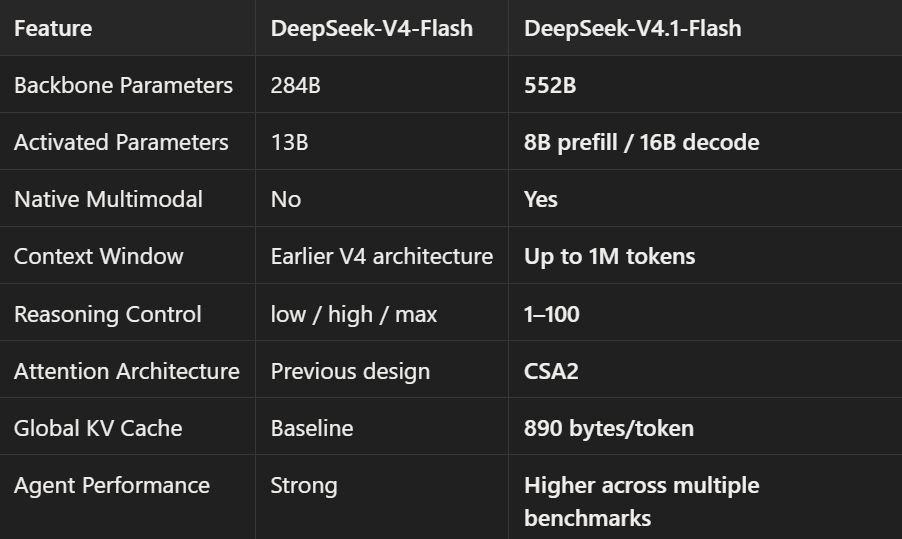
The difference is not just scale.
V4.1-Flash changes how DeepSeek handles memory, attention, multimodal input, and reasoning allocation.
Is DeepSeek-V4.1-Flash Available Through the API?
DeepSeek has officially released V4.1-Flash through its Hugging Face account, and Reuters reported its launch on September 10, 2026.
However, at the time of writing, DeepSeek's public API Change Log does not yet contain a dedicated V4.1-Flash API release entry.
Developers should therefore distinguish between:
official model release
and
hosted API availability
The two may not happen at the same time.
Can DeepSeek-V4.1-Flash Run Locally?
DeepSeek provides model weights and inference guidance for:
- Hugging Face Transformers
- vLLM
- SGLang
- Docker Model Runner
The model is released under the MIT License.
That does not mean it is easy to run on consumer hardware.
A 552B-parameter model still requires substantial accelerator memory and infrastructure, even with sparse activation and aggressive KV cache optimization.
For most developers, hosted or heavily optimized deployments will be more practical.
Final Takeaway
DeepSeek-V4.1-Flash is best understood as an efficiency-focused agent model.
Its 1M-token context window is impressive, but the deeper change is the infrastructure behind it: CED, CSA2, compressed KV cache, sparse activation, and adjustable reasoning effort.
The release points toward a broader direction in frontier AI.
As agents become more persistent and accumulate more context, model quality alone is no longer enough.
Memory efficiency, serving cost, and context management are becoming part of model intelligence.
For that reason, the most important number in DeepSeek-V4.1-Flash may not be 552B parameters.
It may be 890 bytes per token.
FAQ
How is DeepSeek-V4.1-Flash different from DeepSeek-V4-Flash?
V4.1-Flash adds native multimodal input, a 1M-token context window, a new Causal Encoder-Decoder architecture, CSA2 sparse attention, much lower KV cache usage, and 1–100 reasoning control.
Why is 890 bytes per token important?
KV cache can consume large amounts of GPU memory in long-context workloads. Reducing the cache footprint helps make large context windows more practical and can improve concurrency, throughput, and serving efficiency.
Is DeepSeek-V4.1-Flash available through the DeepSeek API?
The model has been officially released, but DeepSeek's public API Change Log does not yet show a dedicated V4.1-Flash API release entry. Developers should verify current API availability before deployment.
Can DeepSeek-V4.1-Flash be used commercially?
The official Hugging Face repository lists the model under the MIT License, which generally permits commercial use, subject to the license terms and any additional applicable platform or deployment requirements.