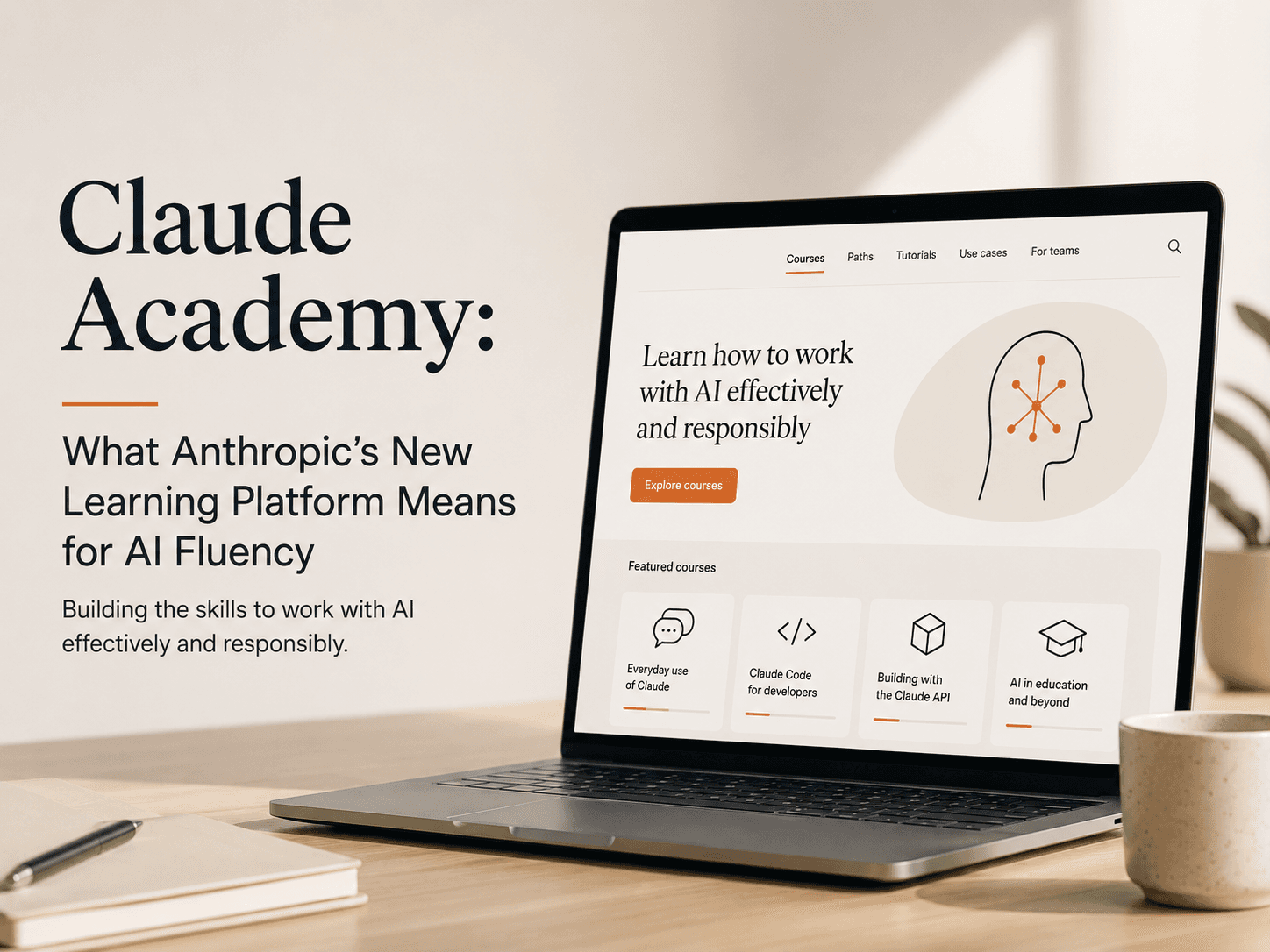
Anthropic launched Claude Academy on August 20, 2026, giving Claude users a central place to learn about its AI products and the skills needed to use them effectively.
The platform includes courses, tutorials, quizzes, practical use cases, and completion badges. Its catalog covers everyday Claude use, Claude Code, the Claude API, AI capabilities and limitations, and applications for education, business, and nonprofit work.
Some of this is straightforward product training. A new Claude user can learn how the product works, while developers can find material related to coding and API development.
But Claude Academy also reflects Anthropic’s wider approach to AI education. The company wants users to learn more than a set of prompts or product features. Its courses place equal emphasis on deciding when to use AI, evaluating its output, and taking responsibility for the finished work.
Anthropic describes this broader set of skills as AI fluency.
What Is Claude Academy?
Claude Academy is Anthropic’s official online learning platform. It brings Anthropic’s educational material into a structured catalog of courses, tutorials, and practical learning resources.
The platform currently covers several main areas:
- Everyday use of Claude
- AI capabilities and limitations
- Anthropic’s 4D AI Fluency Framework
- Claude Code
- Application development with the Claude API
- AI use in education and professional settings
Courses include lessons, practical exercises, and quizzes. Users can track their progress and receive badges after completing eligible courses.
Claude Academy is connected to Anthropic’s products, but the company says some of its educational material is product- and model-agnostic. The goal is not only to explain how Claude works, but also to teach skills that can apply to other AI systems.
That makes the platform different from a conventional product help center. It combines instructions for using Claude with a framework for deciding how AI should fit into a task.
Why Anthropic Is Focusing on AI Fluency
Much of the early education surrounding generative AI concentrated on prompts.
Users were taught formulas, role instructions, formatting techniques, and lists of keywords designed to produce better answers. These techniques can be useful, but they may also age quickly. Models change, interfaces improve, and AI systems become better at understanding natural instructions or requesting missing context.
A prompting rule that feels essential today may become unnecessary after the next product update.
Anthropic’s approach is built around more lasting habits of mind.
The company argues that effective AI use includes the decisions made before and after a conversation with an AI assistant—not only the text typed into a chat box. A user must first decide whether a task should be delegated to AI. The user must then provide sufficient direction, assess the output, verify important claims, and determine how the AI’s involvement should be disclosed.
This is why Claude Academy emphasizes judgment alongside technical skill.
Anthropic highlights practices such as verifying AI output in proportion to the stakes. A casual brainstorming session and a legal, medical, financial, or business-critical document should not receive the same level of review.
The result is a definition of AI fluency that is closer to professional judgment than simple software proficiency.
The 4D AI Fluency Framework
At the center of Claude Academy is the 4D AI Fluency Framework, which organizes effective human–AI collaboration into four connected competencies.
1. Delegation
Delegation means deciding what AI should do, what the human should do, and how the work should be divided.
This step comes before prompting. Not every task should be handed to an AI system, and many tasks are better divided into stages.
A person may use AI to organize research, identify patterns, or draft routine material while keeping sensitive decisions, final review, or high-stakes judgment under human control.
The important question is not simply:
Can AI do this?
It is:
What role should AI play in this specific task?
This distinction becomes increasingly important as AI systems gain the ability to perform longer and more complex workflows. Greater technical capability does not automatically mean that every available task should be fully automated.
2. Description
Description is the ability to communicate a task, its context, its constraints, and the desired result clearly enough for an AI system to provide useful assistance.
This includes more than writing a polished prompt. It may require explaining the intended audience, supplying reference material, defining what success looks like, identifying boundaries, or showing examples of the expected output.
For example, asking an AI assistant to “write a report” leaves many decisions undefined. A more useful description could explain:
- Who will read the report
- What decision the report should support
- Which sources may be used
- Which claims require verification
- What tone and format are expected
- What information must not be included
As AI systems become more capable, the mechanics of prompting may change. The need to express goals and context clearly is likely to remain.
3. Discernment
Discernment means critically evaluating what the AI produces.
An answer can sound confident and still be incomplete, inaccurate, poorly reasoned, or unsuitable for its intended audience. AI fluency therefore requires users to compare outputs with their goals, inspect important details, notice omissions, and request revisions when necessary.
This is especially important because fluent language can create the appearance of reliability. A well-written answer is not automatically a correct answer.
In practice, discernment turns AI use from passive acceptance into an iterative process. The user is not merely receiving an output but judging whether that output solves the original problem.
4. Diligence
Diligence covers the responsibilities surrounding AI-assisted work.
This can include:
- Checking important facts
- Protecting sensitive information
- Considering possible harms
- Preserving human accountability
- Following relevant organizational policies
- Disclosing AI involvement when appropriate
Diligence reinforces a principle that can easily disappear when AI makes work faster: the human remains responsible for deciding whether the result is ready to use or share.
Together, the four dimensions describe a complete workflow, from deciding whether to involve AI to taking responsibility for the final outcome.
Claude Academy Starts With Tasks, Not Features
Anthropic says AI education should begin with the problems people want to solve, rather than a list of product features.
Claude Academy follows this approach by connecting its lessons to practical activities such as writing, research, data analysis, software development, and teaching. Users learn not only how to operate Claude, but also when AI is appropriate and how carefully its output should be reviewed.
The distinction matters: knowing what an AI tool can do is not the same as knowing when to use it.
From Internal Training to a Public Learning Platform
Claude Academy draws partly on the way Anthropic trains its own employees.
The company introduces AI fluency during employee onboarding. New employees learn the 4D framework, examine common mistakes, and practice deciding which parts of a task should remain under human control.
Anthropic describes its continuing education model as “ever-boarding.” Instead of treating AI training as a one-time session, the company updates learning as AI systems and their limitations change.
That model makes sense for a technology that develops quickly. Instructions written for an earlier model may no longer match the capabilities or risks of a newer system.
By incorporating this philosophy into Claude Academy, Anthropic is making part of its internal training approach available to the public.
This could also make the platform useful to organizations adopting Claude. Giving employees access to an AI product does not establish shared rules for reviewing outputs, handling sensitive information, or deciding which tasks should be automated.
A framework such as the 4Ds cannot replace an organization’s own policies, but it gives teams a common vocabulary for discussing those questions.
Claude Academy Expands Anthropic’s Role
Claude Academy shows how the role of an AI company is expanding.
Anthropic already develops the Claude models and the products built around them. Through the Academy, it is also teaching users how those systems should be incorporated into work and learning.
This has a practical benefit for Anthropic. People are more likely to receive useful results from Claude if they understand how to provide context, divide tasks, and review the output.
It also allows the company to influence how AI competence is defined.
The first wave of generative AI training often focused on prompt engineering. Claude Academy uses a broader definition. Under the AI fluency framework, an effective user is someone who can decide what to delegate, describe the task clearly, evaluate the result, and use it responsibly.
These skills are not limited to one Claude interface or model version. They can still apply when products change or when users work with another AI system.
Anthropic is therefore using Claude Academy for two related purposes: helping customers use its products and promoting its preferred model of human–AI collaboration.
What Claude Academy Does Not Yet Establish
Claude Academy provides a structured account of Anthropic’s AI education strategy, but it is still a new platform.
Its launch does not show how many users will complete the courses, whether organizations will incorporate the material into employee training, or how effectively the courses improve real-world AI use.
Anthropic also describes the current platform as an early stage of what it hopes to build. The company expects future AI capabilities to support more personalized and interactive forms of learning.
The completion badges should also be understood accurately. Anthropic’s official pages mention badges for finishing courses, but they do not describe them as accredited qualifications or professional certifications.
For now, Claude Academy is best viewed as an official learning hub for Claude and AI fluency. Its longer-term value will depend on how the curriculum develops and whether learners can apply its framework outside the courses themselves.
Final Thoughts
Claude Academy gives Anthropic a single platform for product education, developer training, and broader AI literacy.
Its most distinctive element is the 4D AI Fluency Framework. Rather than treating AI competence as a collection of prompting techniques, the framework covers the full process of working with AI: deciding what to delegate, explaining the task, evaluating the response, and remaining responsible for the result.
The Claude-specific courses may help Anthropic bring more users into its product ecosystem. The model-agnostic material has a wider purpose. It presents Anthropic’s view of the skills people will need as AI becomes part of everyday work and education.
FAQ
What is Claude Academy?
Claude Academy is Anthropic’s official online learning platform. It offers courses, tutorials, quizzes, practical use cases, and completion badges covering Claude products and broader AI fluency skills.
What can you learn in Claude Academy?
Claude Academy includes material on everyday Claude use, AI capabilities and limitations, Claude Code, application development with the Claude API, and Anthropic’s 4D AI Fluency Framework. It also includes courses for areas such as education, business, and nonprofit work.
What are the four dimensions of AI fluency?
Anthropic’s 4D AI Fluency Framework consists of Delegation, Description, Discernment, and Diligence. The four dimensions cover deciding how AI should be used, explaining a task clearly, evaluating the output, and using the result responsibly.
Is Claude Academy only for Claude users?
No. Claude Academy includes product-specific training for Claude, Claude Code, and the Claude API, but Anthropic says it also provides product- and model-agnostic AI education. Concepts such as delegation and output evaluation can be applied to other AI systems.
Does Claude Academy offer certification?
Claude Academy offers completion badges for eligible courses. Anthropic’s official pages do not describe these badges as professional certifications or accredited qualifications.