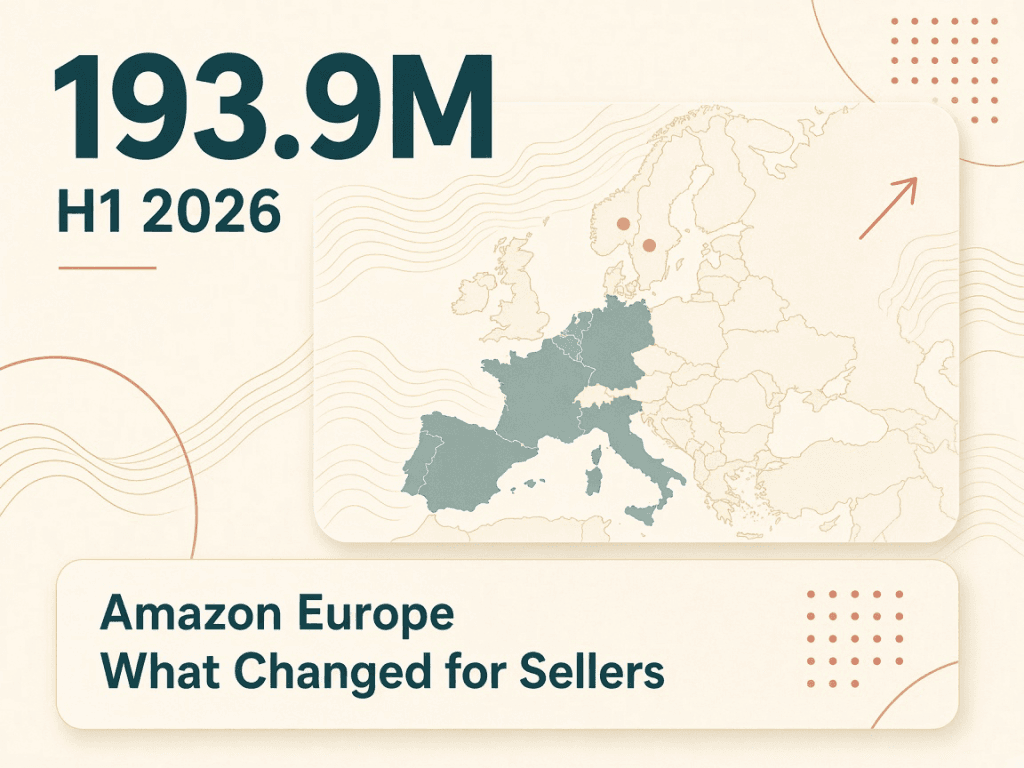
Amazon is still huge in Europe. It is no longer growing evenly.
In its latest Digital Services Act filing, Amazon said the Amazon Store reached 193,929,458 average monthly active recipients (AMAR) in the EU from 1 January to 30 June 2026. That is about 1.25 million people fewer than the 195,184,376 it reported for July to December 2025, a drop of 0.6%.
If you stop at the headline, you will make the wrong call. This is not a collapse. It is a plateau in the big markets, with growth moving to smaller ones. For sellers, that split matters more than the EU total.
193.9 million is reach, not buyers
AMAR is a compliance metric, not a sales metric.
Under Article 24(2) of the Digital Services Act, very large platforms must publish the average number of monthly active recipients in the EU every six months. For Amazon, that means people who used its shopping service in a given month, averaged across the half. It does not mean they placed an order.
A user who opened the app, compared a listing, or clicked through from a search ad can count. A buyer who purchased once and did not come back in later months may not. Treat 193.9 million as service reach, then judge conversion with your own session, conversion, and advertising data.
One more limit: Amazon and other platforms have changed how they count these figures. After last year’s reporting template was aligned, only the last two halves can be compared cleanly. Older filings are useful for direction, not for precise period-to-period math.
The EU total looks soft. The year-on-year picture does not.
Half-on-half, Amazon lost about 1.3 million recipients. That is the number most coverage leads with.
Look at the same filing over a full year and the story changes. Independent compilers of the DSA disclosures put Amazon about 14.1 million recipients above H1 2025. That would make H1 2026 its strongest first half on record. Since 2023, Amazon’s EU reach has also followed a seasonal pattern: the second half, which includes Prime Day leftovers, Black Friday, and Christmas, usually beats the first halves on either side of it.
So the useful reading is narrower:
- Europe is not a land-grab market anymore.
- Holiday halves still lift the headline number.
- A 0.6% dip after peak season is not the same thing as demand leaving the platform.
Germany still leads. France cooled the most.
Amazon’s own country rows still put the same four markets at the top.
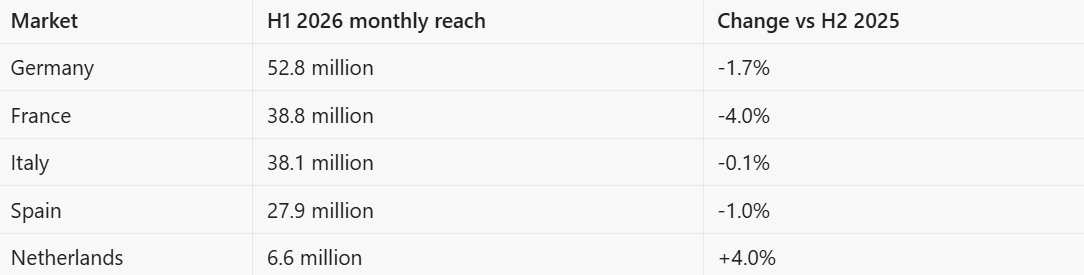
Germany remains Amazon’s largest EU audience and its largest European sales market. Italy barely moved. Spain slipped a little. France took the sharpest hit among the core five.
The Netherlands is the only one of those five that grew. It is also the smallest, and the last of the group to get a standalone Amazon store. Reach going up there is real. It is not proof that Amazon has taken the market.
ECDB figures reported by Ecommerce News put Bol at €5.81 billion in Dutch online spending for 2025, up 12.0%. Amazon.nl was €3.31 billion, up only 2.7%. Bol’s lead widened from about 61% larger than Amazon in 2024 to more than 75% larger in 2025. Amazon has said it will put €1.4 billion over three years into the Netherlands. More users and a large investment can sit next to a widening sales gap. They often do, when a local incumbent already owns habit and assortment.
Growth moved north. Greece went the other way.
Outside the core five, the filing is uneven.
Denmark posted the fastest gain in the EU, +18.4% versus the previous reporting period. Sweden rose 13.9%. Ireland rose 12.1%. Those are not Amazon’s biggest profit pools today. They are the markets where incremental reach is still available.
Greece is the warning case. Amazon’s reach there fell 20.2%, the steepest drop in the bloc. The local leader is Skroutz, not Amazon. If a market already has a trusted comparison or marketplace brand, DSA reach can shrink even while the country’s ecommerce pie grows.
The seller takeaway is blunt: do not read “Amazon Europe” as one campaign. Germany and France need listing quality, reviews, and advertising efficiency. Nordics and Ireland still reward expansion work. Greece needs a local-competitor plan before it needs a bigger ad budget.
What this filing should change in your 2026 plan
Use the data. Do not copy the headline into a strategy deck.
- Keep the Big Four, stop expecting easy audience growth. Germany, France, Italy, and Spain still concentrate most of Amazon’s EU reach. Winning there now looks like conversion rate, share of voice, and repeat purchase, not “new users arriving every month.”
- Build a second-wave country list. Netherlands, Sweden, Ireland, and Denmark are where the filing still shows expansion. Local language, VAT, and delivery promises matter more in these markets than another generic Europe campaign.
- Separate reach from revenue. A country can add AMAR and still lose share to a local platform. The Netherlands is the current example. Pair DSA figures with marketplace GMV, category share, and your own TACOS.
- Watch compliance as a commercial issue. Amazon has published DSA reports since 2023 and was designated a very large online platform in April 2023. Product safety, IP complaints, and listing accuracy are now part of how the store is supervised, not a side legal topic.
Amazon is also pushing AI tools on both sides of the checkout, including seller tools for inventory and brand work, and the Rufus shopping assistant for European shoppers. In a market where reach is flatter, the listings that get recommended, compared, and trusted will take more of the same traffic.
FAQ
Did Amazon lose users in the EU?
It lost reach against the previous half, down about 1.25 million people or 0.6% from H2 2025. Against H1 2025, compiled DSA figures still show a gain of about 14.1 million. The safer description is slower growth and normal seasonality, not a structural retreat.
Does monthly active recipients mean paying customers?
No. AMAR counts people who used Amazon’s shopping service in a month, averaged over six months. It is not the same as unique buyers, orders, or GMV.
Which EU country has the most Amazon users?
Germany. Amazon reported 52.8 million average monthly recipients there in H1 2026. France, Italy, and Spain follow. The Netherlands is much smaller at 6.6 million, but it was the only one of those five markets to grow.
Why is Greece shrinking for Amazon?
Amazon’s H1 2026 reach in Greece fell 20.2%. Local competition is the main commercial explanation. Skroutz is the leading ecommerce destination there, so Amazon is not the default starting point for many shoppers.
Can I compare this report with Amazon’s 2023 or 2024 DSA numbers?
Only with caution. Platforms have revised counting methods, and the EU reporting template was standardised more recently. Amazon’s last two halves are the clean comparison. Older reports should be used for context, not for exact growth rates.
Sources
- Amazon. Digital Services Act (DSA) Amazon EU Store. Updated 31 August 2026. Official hub for Amazon’s EU DSA reports and related filings.
- Social Media Transparency. H1 2026 EU user numbers. 1 September 2026. Independent compilation of platform DSA filings, including Amazon’s exact AMAR totals and the +14.1 million year-on-year comparison.