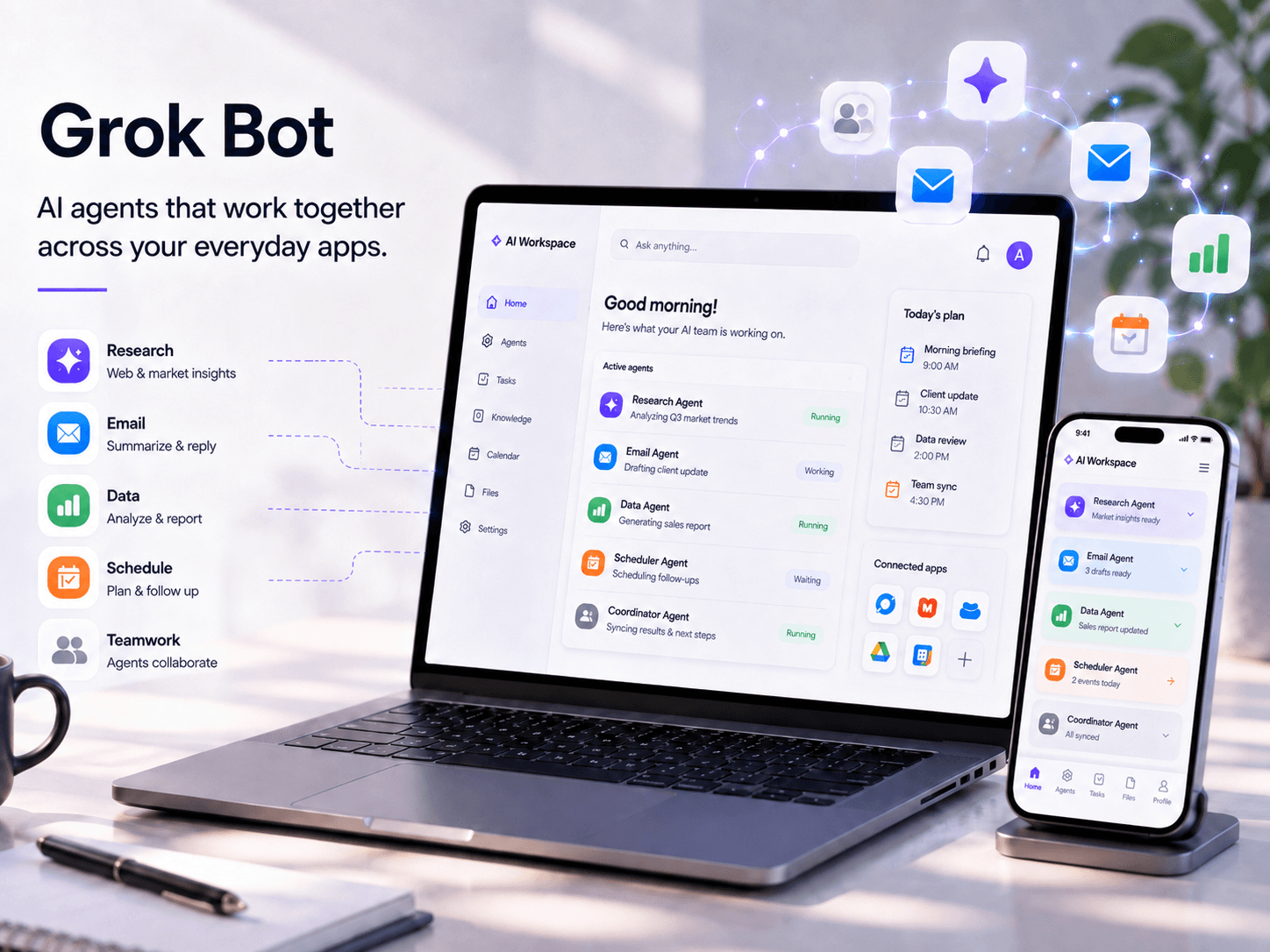
Grok Bot has attracted attention because it points to a different way of using AI at work. Instead of treating AI as a tool that answers one prompt at a time, the concept is built around assigning work to multiple AI assistants.
According to an AMZ123 report citing Bloomberg, Grok Bot is designed as a team of AI assistants that can work across the apps and websites people already use. The report says the Bots can retain information from earlier tasks and share relevant task details and context.
That distinction matters for ecommerce sellers. Most sellers do not need another tool that simply writes product copy. They need help connecting research, customer service, reporting, supplier communication, and day-to-day operations.
The potential value of Grok Bot is its ability to coordinate those steps.
The key idea: Bots can work together
The most important reported feature is not simply that several Bots can run at the same time. It is that they can collaborate around related tasks.
For example, an ecommerce workflow might involve:
- reviewing competitor pricing and product positioning;
- analyzing customer reviews;
- checking sales or inventory information;
- summarizing the findings;
- preparing an internal update or follow-up email.
Under the model described in the AMZ123 report, different Bots could handle different parts of that process while sharing relevant information. One Bot might gather research, another could organize the findings, and another could prepare a summary for review. The report does not publicly explain every technical step in that handoff, so the safest description is that Grok Bot is intended to support coordinated, multi-agent work—not merely unrelated tasks running in parallel.
For sellers, this could reduce the amount of manual copying and pasting between browser tabs, spreadsheets, email, and marketplace tools.
What Grok already offers around this concept
Some of the surrounding capabilities are documented by SpaceXAI for Grok more broadly.
Grok’s official product information lists real-time web and X search, file and PDF analysis, and higher-tier multi-agent reasoning.
SpaceXAI has also launched Connectors that allow Grok to work with services such as Outlook, OneDrive, Google Workspace, Notion, GitHub, and Linear. The company says Grok can search and summarize information, work with files, draft or send emails, organize calendars, and edit documents or spreadsheets, depending on the connector and permissions enabled.
Its Automations feature allows users to describe a recurring job once and have Grok run it on a schedule or when a matching email arrives. Each run is saved as a conversation that can be reviewed later.
These are confirmed Grok capabilities. They provide useful context for understanding the direction of Grok Bot, but they should not automatically be treated as proof that every one of these functions is already available in Grok Bot or natively integrated with every ecommerce platform.
Where ecommerce sellers could use it
1. Competitor and market research
A seller could use a coordinated workflow to monitor public competitor information, collect recurring themes from customer reviews, and prepare a market update.
One Bot might gather publicly available information, while another organizes the results by price, features, complaints, or promotional language. A third could turn the findings into a short report.
Grok’s real-time web and X search are relevant here because product categories can change quickly and customer conversations often appear outside formal marketplace reports.
The results would still require review. Public listings may be incomplete, prices can change, and social-media discussion is not the same as verified sales performance.
2. Customer-support triage
Customer service is another area where multiple Bots could divide the workload.
One Bot could classify incoming tickets. Another could identify whether the issue relates to delivery, product setup, returns, or a recurring defect. A third could prepare a draft response using the seller’s approved policies and tone of voice.
This could be useful for repetitive questions, but sellers should keep human approval for refunds, chargebacks, compensation, account-health disputes, and legal or intellectual-property complaints.
A polished response is not enough if the underlying order information or policy interpretation is wrong.
3. Sales, advertising, and inventory reporting
Reporting is a practical starting point because it usually follows a repeatable format.
A seller might assign separate tasks to collect sales figures, review advertising spend, check inventory levels, and summarize returns or support volume. If the Bots can share their findings, the final report could connect those signals instead of presenting four unrelated data tables.
For example, a report might flag that ad traffic is increasing while inventory is falling, or that a rise in returns is concentrated around one product variation.
That kind of analysis could help sellers identify operational problems earlier, although the accuracy will depend on the data sources and permissions available to the system.
4. Email and document processing
The AMZ123 report describes internal use cases that include finding potential customer accounts, drafting emails overnight, and extracting receipt information from email. It also says SpaceXAI has tested Grok Bot across areas including engineering, growth, marketing, sales, and finance.
For ecommerce businesses, similar workflows could include organizing supplier messages, extracting shipment details, preparing purchase-order summaries, or turning scattered updates into a weekly operations brief.
These tasks are attractive because they are time-consuming but relatively structured. They also allow a human to review the result before anything is sent externally.
5. Standard operating procedures
Many ecommerce teams rely on informal processes: how to prepare a launch checklist, how to review an advertising report, how to respond to a supplier delay, or how to summarize a customer complaint.
A multi-agent system could make those procedures more repeatable by assigning clear roles to different Bots and using the same instructions each time.
The benefit is greater consistency across employees, contractors, and virtual assistants.
What sellers should verify before relying on Grok Bot
The available reporting does not confirm unrestricted, native access to every ecommerce platform. Sellers should not assume that Grok Bot can automatically operate Amazon Seller Central, Amazon Ads, Shopify Admin, Walmart Marketplace, or another dashboard simply because Grok supports connectors or tool use in other contexts.
Before connecting a live business account, sellers should verify:
- which applications are supported;
- whether the connection is read-only or allows changes;
- what authentication method is required;
- whether every external action requires approval;
- whether activity logs are available;
- how customer, financial, and supplier data are handled.
A sensible rollout would begin with research, reporting, ticket classification, document organization, and email drafts. Changes to prices, ad budgets, payouts, refunds, tax settings, and product listings should remain restricted until the workflow has been tested thoroughly.
FAQ
What is Grok Bot?
According to an AMZ123 report citing Bloomberg, Grok Bot is being developed as a multi-agent system in which several AI assistants can work across apps and websites while retaining task information and sharing relevant context.
Is Grok Bot publicly available?
Grok Bot was officially introduced by SpaceXAI on August 11, 2026 as an early-beta product. Availability may still be limited by platform, account type, or rollout status, so users should check the latest official access requirements.
Is Grok Bot the same as the regular Grok assistant?
No. Grok Bot is a separate agent-based product designed around AI teammates that can carry out multi-step work across tools and applications. It sits within the broader Grok ecosystem, but should not be treated as identical to the standard Grok assistant.
Can Grok Bot run an ecommerce store automatically?
There is not enough verified public information to make that claim. The reported capabilities do not confirm unrestricted access to every marketplace or store-management dashboard.
What should sellers test first?
Low-risk workflows such as market research, weekly reporting, receipt extraction, support-ticket triage, and email drafting are the most practical starting points. Financial, account-level, and customer-remedy actions should remain subject to human approval.
Sources
- AMZ123: “SpaceXAI Launches AI Collaboration Tool Grok Bot,” August 12, 2026. The article attributes its Grok Bot reporting to Bloomberg and describes multi-agent collaboration, app and website access, shared context, and internal use cases.
- SpaceXAI: “Introducing Grok Bot,” August 11, 2026. Official announcement covering Grok Bot’s early-beta launch, cross-app work, coordinated multi-Bot workflows, shared context, saved routines, availability, and internal use cases.
- SpaceXAI: “Connectors in web, iOS, and Android.” Official documentation of Grok’s integrations with email, files, calendars, documents, spreadsheets, and other tools.
- SpaceXAI: “Automations in Grok.” Official documentation of scheduled and email-triggered recurring jobs.