DeepSeek released the final version of DeepSeek V4-Pro on August 13, 2026, with DeepSeek V4-Pro as its API model name.
At first glance, this looks like another frontier-model update: better benchmark scores, broader API compatibility, and a new pricing schedule. But the announcement points to a larger shift.
DeepSeek is no longer competing only on how well a model answers questions. V4-Pro is designed for codebases, terminals, external tools, and multi-step workflows—the kinds of environments where AI agents are expected to complete work rather than simply generate responses.
The Biggest Gains Are in Agentic Work
DeepSeek’s benchmark table focuses heavily on software engineering, repository navigation, terminal use, cybersecurity environments, tool calling, and office automation.
Compared with the earlier V4-Pro Preview, the final release posts substantial gains:
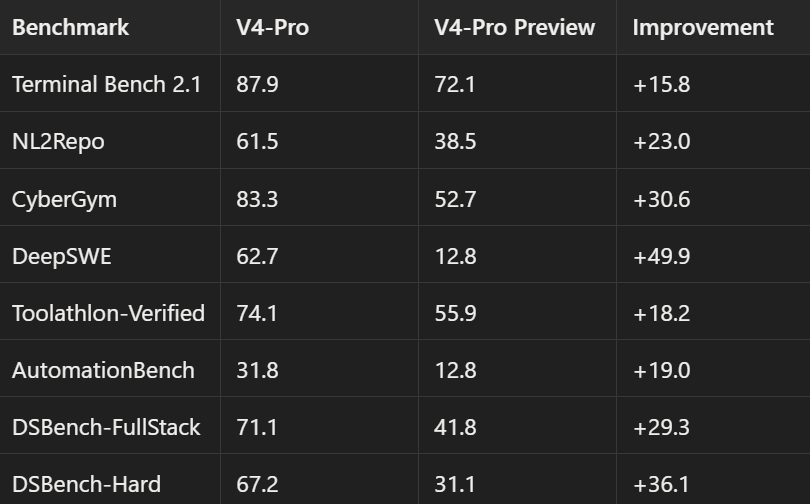
The most dramatic jump appears on DeepSWE, where V4-Pro improves from 12.8 to 62.7.
Software-engineering benchmarks test more than code generation. A capable coding agent must understand an existing project, locate the relevant files, make coordinated changes, run tests, interpret failures, and continue without losing track of the objective.
The gains on CyberGym and NL2Repo also suggest stronger performance in security-oriented environments and repository-level reasoning.
Still, the results should not be turned into a “DeepSeek beats everything” headline. V4-Pro does not lead every benchmark in DeepSeek’s comparison table. Its Terminal Bench 2.1 score is close to Kimi-K3 and Fable 5, while competing models remain ahead on several repository, software-engineering, and tool-use evaluations.
The more defensible conclusion is that V4-Pro has made a major leap over DeepSeek’s preview model while remaining competitive across a broad range of agent tasks.
These are also company-reported results. Actual performance will depend on prompts, tools, execution environments, and evaluation settings. Production teams should focus on completion rate, failure recovery, cost, and predictability—not a single leaderboard score.
Responses API Compatibility and Codex Support
DeepSeek has added a Responses API-compatible endpoint for V4-Pro. This makes the model easier to use with clients built around the Responses API format, but it does not provide full feature parity with every implementation of that API.
DeepSeek’s documentation lists support for:
- Function calling
- Server-side web search
- Streaming
- The custom apply_patch tool used for Codex compatibility
The same documentation says file_search, code_interpreter, computer_use, mcp, and other built-in tool types are ignored. The API also does not support previous_response_id, persistent conversations, response storage, or context_management.
In practical terms, DeepSeek supplies the model, a compatible API format, web search, function calling, and support for Codex’s patching workflow. Developers must still provide their own file access, code-execution environment, MCP connections, conversation history, and context-management system when those capabilities are required.
DeepSeek says its models can be used in Codex through the Responses API format with a relatively simple configuration change. Support for apply_patch allows Codex to submit structured file edits.
That gives developers another model option for repository-level coding workflows, but the surrounding agent infrastructure remains the responsibility of Codex or another client. DeepSeek’s Responses API is stateless, so the client must manage conversation history, context trimming, and any long-term task state.
The result is meaningful interoperability rather than a fully managed agent platform.
Peak and Off-Peak Pricing Changes the Economics
DeepSeek is also introducing time-based pricing for V4-Pro.
As of August 14, 2026, the official pricing page lists the following rates:
- Cached input: $0.003625 per million tokens
- Uncached input: $0.435 per million tokens
- Output: $0.87 per million tokens
A new peak and off-peak schedule will take effect at 4:00 p.m. UTC on August 16, 2026.
Peak hours will run from 1:00–4:00 a.m. UTC and 6:00–10:00 a.m. UTC. All other hours will be treated as off-peak.
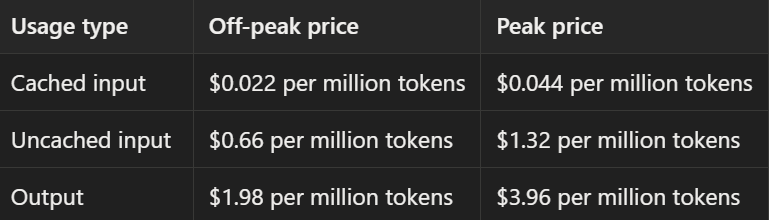
The off-peak rate will be half the peak rate, although both new pricing bands are higher than the rates listed before the change takes effect.
That difference could influence how companies schedule agent workloads.
Interactive applications such as customer support and real-time coding assistance must respond when users need them. Repository scans, batch processing, knowledge-base updates, report generation, and offline evaluations can often run outside peak hours.
Once agents begin operating for hours and making repeated model calls, execution time becomes a cost variable. Teams may optimize not only prompts and cache-hit rates, but also job queues and scheduling policies.
From Generating Answers to Completing Work
For teams deploying agents, the practical questions are different:
- Can the agent finish the assignment?
- Can it recover when a tool fails?
- Can it use external systems correctly?
- Can it stay on track during a long task?
- Can its cost be predicted and controlled?
V4-Pro’s benchmark suite emphasizes terminals, repositories, security environments, automation, and full-stack development. Its Responses API compatibility makes it easier to connect the model to existing agent clients, while its Codex support targets repository-level software-engineering workflows.
The next question is whether those reported gains translate into reliable performance inside real codebases and business processes.
Independent testing will be essential. Developers will need to evaluate task-completion rates, behavior after errors, instruction retention, and total operating costs.
If V4-Pro can turn its benchmark gains into consistent production performance, DeepSeek will be competing not only with other foundation models, but also for a place inside the broader systems developers use to build and operate AI agents.
FAQ
What is DeepSeek V4-Pro?
V4-Pro is the Pro model in DeepSeek’s V4 family. The current API version is listed as DeepSeek-V4-Pro-0813 and is available through the model name deepseek-v4-pro.
What does its Responses API-compatible endpoint support?
It supports function calling, server-side web search, streaming, and apply_patch for Codex compatibility. File search, Code Interpreter, computer use, MCP, persistent conversations, and server-side context management are not currently supported.
Can DeepSeek V4-Pro be used with Codex?
Yes. DeepSeek says V4-Pro can be used with Codex through its Responses API-compatible endpoint. The integration supports apply_patch for structured file edits, while Codex or another client remains responsible for conversation history, context management, and the surrounding execution environment.