What Is Selling Well on Amazon in 2026?
There is no single fixed ranking that can accurately describe Amazon sales for the entire year. Best Sellers rankings change with pricing, promotions, seasonality, inventory, and competition.
However, Amazon published a useful product-research article on January 16, 2026, highlighting products selected from its Best Sellers category lists. These products should be treated as research candidates—not guaranteed winners or a complete 2026 sales ranking.
There is also a small counting issue in Amazon’s article. Its headline refers to 18 product categories, but the list contains 17 distinct product types because both Home & Kitchen and Kitchen & Dining point to insulated tumblers.
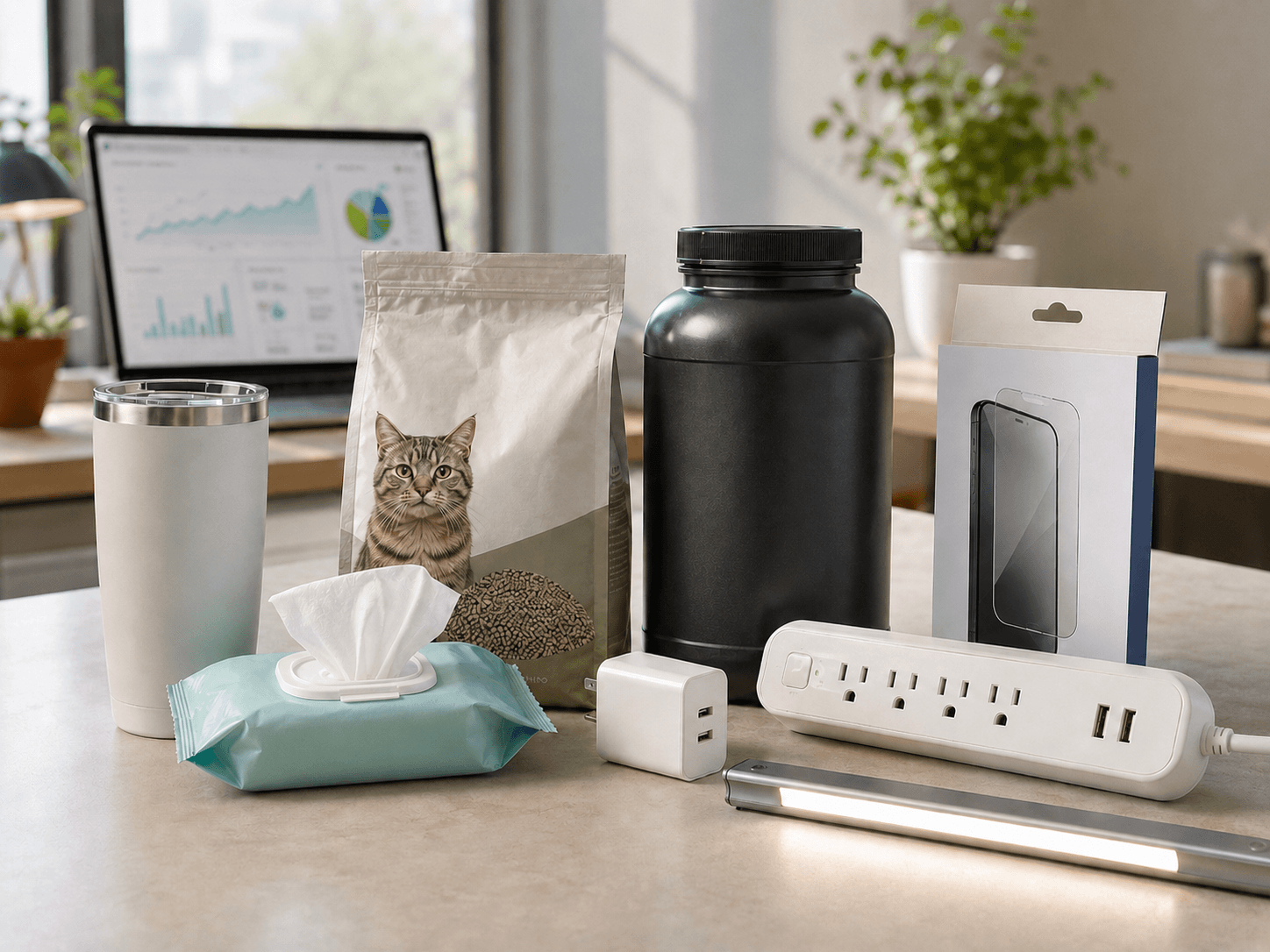
This article focuses on eight representative product types. They illustrate four different sources of demand:
- Repeat purchase
- Existing product ecosystems
- Everyday problem-solving
- Differentiation within mature categories
8 Product Types to Watch
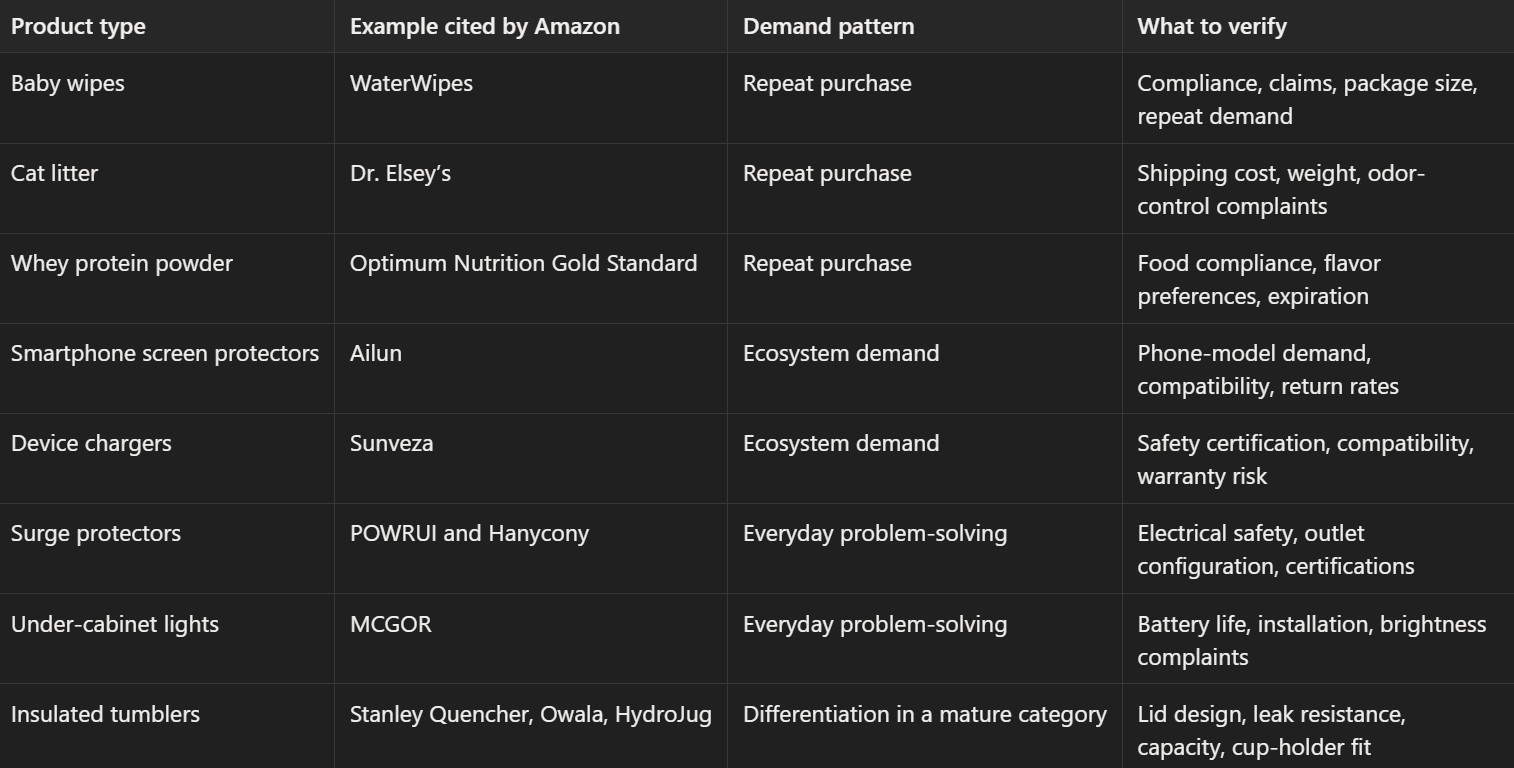
Amazon’s article provides product examples, category placement, customer-feedback themes, bestseller or Amazon’s Choice references, and product features. These are useful product-level signals, but they are claims from Amazon’s own editorial content—not independent verification of current sales volume.
1. Repeat Purchase: Demand That Comes Back
Baby wipes, cat litter, and whey protein powder share a fundamental characteristic: customers consume or regularly use them and eventually need more.
This pattern also appeared in Helium 10’s November 2025 analysis, which included coffee pods, diapers, toilet paper, protein shakes, electrolytes, and energy drinks among products with high estimated monthly revenue. Helium 10’s figures were third-party estimates, not Amazon-reported sales data.
For sellers, the important question is not simply whether a product is consumable. The real question is whether repeat demand survives the economics of the category:
- Can the product be shipped profitably?
- Are customers loyal to established brands?
- Are there expiration or compliance requirements?
- Can advertising costs be supported by the expected reorder rate?
A product with frequent repeat purchases can still be unattractive if margins are too thin or fulfillment costs are too high.
2. Ecosystem Demand: Sell Around Products Customers Already Own
Screen protectors and device chargers benefit from an existing installed base.
Customers already own smartphones, tablets, laptops, cameras, and gaming devices. Those core products create demand for related accessories such as:
- Cases
- Screen protectors
- Chargers
- Cables
- Mounts
- Stands
This changes the product-research question from:
What completely new product can I invent?
to:
What else does the customer need after buying a product they already use?
The main risk is intense comparability. Customers can quickly compare price, compatibility, materials, package quantity, charging speed, and installation convenience. A small specification error can also create a high return rate.
3. Everyday Problems Create Understandable Demand
Surge protectors and under-cabinet lights solve simple problems.
A surge protector expands access to power and adds protection features. An under-cabinet light improves visibility in kitchens, offices, workshops, or other areas where overhead lighting is insufficient.
Products in this category usually require less customer education than products based on a completely new concept. The competition therefore moves toward execution:
- Does the product fit better?
- Is installation faster?
- Does it include the right accessories?
- Is the battery reliable?
- Are the instructions clear?
- Does it solve a narrower use case better than existing products?
The product does not need to be revolutionary. It needs to solve a familiar problem more effectively.
4. Mature Categories Still Allow Differentiation
Insulated tumblers are a mature category, but they continue to attract strong consumer attention. Amazon’s 2026 product article specifically mentions brands such as Stanley Quencher, Owala, and HydroJug.
The opportunity is unlikely to be “another generic tumbler.” Differentiation may come from details such as:
- Lid design
- Leak resistance
- Cup-holder compatibility
- Handle configuration
- Cleaning convenience
- Capacity
- Weight
- Color and style
- Use-specific design
This illustrates an important product-research principle:
A mature category can still contain an unmet need.
The opportunity may be a product that addresses one recurring complaint better than existing alternatives.
A Seven-Factor Product Evaluation Framework
Before sourcing a product, evaluate it across these seven factors.
1. Demand
Check search volume, purchasing trends, seasonality, and whether demand appears stable, growing, or temporary.
A product appearing in a Best Sellers category can be a useful signal, but a short-term sales spike is not the same as durable demand.
2. Competition and Saturation
Examine how concentrated sales are among established brands, how many strong competitors dominate the first page, and whether an underserved customer segment still exists.
High demand with extreme saturation may be less attractive than moderate demand with a clear market gap.
3. Unit Economics
Calculate the complete contribution margin:
Selling price
− product cost
− freight
− Amazon fees
− fulfillment
− advertising
− returns
= contribution margin
A product is not attractive if it is profitable only under unusually optimistic assumptions.
4. Reviews and Customer Complaints
Reviews are product-research data, not just social proof.
Look for complaints that repeat across several competing listings:
- Poor fit
- Weak materials
- Difficult installation
- Confusing instructions
- Missing accessories
- Inaccurate dimensions
- Battery or charging problems
Recurring complaints may reveal an opportunity for product improvement.
5. Returns and Operational Risk
Consider whether the product is fragile, bulky, difficult to use, easy to install incorrectly, or likely to create compatibility and sizing problems.
A product with slightly lower demand but fewer structural return problems may produce healthier long-term economics.
6. Compliance and Documentation
Confirm whether the category requires special certification, labeling, testing, packaging, or advertising restrictions.
This is particularly important for baby products, food and supplements, electrical devices, chargers, lighting, and pest-control products.
7. Visible Differentiation
Ask whether a shopper can understand the product advantage quickly.
A stronger product benefit should be easy to demonstrate through:
- Dimension images
- What’s-included graphics
- Installation steps
- Material close-ups
- Lifestyle images
- Comparison charts
If the difference is difficult to communicate quickly, it may be too weak at the point of purchase.
Amazon’s Product Opportunity Explorer can help sellers examine demand, competition, search terms, reviews, returns, and potential unmet customer needs. These signals are more useful than bestseller visibility alone.
From Product Gap to Listing Advantage
Finding an underserved need is only the first half of the work. The listing must make the improvement obvious to shoppers.
Amazon A+ Content supports enhanced images, comparison charts, videos, lifestyle photography, and customized text to help customers understand a product’s benefits.
This is where BeePOP fits into the product-launch workflow.
BeePOP helps sellers turn a single SKU photo into a complete set of Amazon listing visuals, including:
- Lifestyle images
- Product-detail images
- Dimension graphics
- Feature explanations
- Comparison charts
- What’s-included visuals
- A+ Content assets
For example, a better-fitting screen protector needs a clear compatibility chart. A longer-lasting under-cabinet light needs a battery-life comparison. A differentiated tumbler needs visuals that show its lid, handle, capacity, and cup-holder fit.
The product advantage should be visible before the customer has to read the entire listing.
Find the gap. Build the better product. Make the difference visible with BeePOP.
Final Takeaway
Amazon’s January 2026 product examples point to four durable demand patterns:
- Replenishment
- Existing product ecosystems
- Everyday problem-solving
- Differentiation within mature categories
None of these patterns proves that a specific product is worth selling.
The stronger process is to identify a product with credible demand, investigate competition and customer complaints, calculate the complete unit economics, confirm compliance requirements, and develop an improvement that shoppers can immediately understand.
The goal is not to copy what is already selling.
It is to understand why customers are buying—and what existing sellers still have not solved.
FAQ
Is this a list of Amazon’s best-selling products for all of 2026?
No. The product examples come from Amazon’s January 16, 2026 editorial selection based on Best Sellers category lists. Amazon rankings change over time, so this article should be treated as a product-research snapshot rather than a fixed annual ranking.
Does high demand mean a product is worth selling?
No. Demand must be evaluated together with competition, margins, reviews, returns, seasonality, compliance, and differentiation.
Why does the article discuss Helium 10’s 2025 data?
It is included only as historical context. Helium 10’s figures are third-party estimates and should not be presented as current 2026 Amazon sales data.
How can sellers validate a product opportunity?
Use Best Sellers lists to identify demand signals, then check search trends, competition, saturation, reviews, returns, pricing, compliance, and contribution margin. Amazon’s Product Opportunity Explorer can help organize several of these marketplace signals.