Introduction
The Amazon kitchen products category includes much more than cookware and appliances. Many listings focus on smaller household problems, such as limited cabinet space, messy drawers, food splashes, wet vegetables, and opened bottles.
An AMZ123 product roundup published on August 28, 2026, listed 10 kitchen-related products and reported estimated monthly revenue, estimated unit sales, ratings, and review counts. The products covered storage, cleaning, food preparation, and household convenience. These figures are third-party estimates, not official Amazon sales disclosures.
The purpose of this article is not to reproduce the original product descriptions. Instead, it examines what the list may indicate about customer needs, competition, and the risks involved in Amazon kitchen product research.
Product Categories Reported by AMZ123
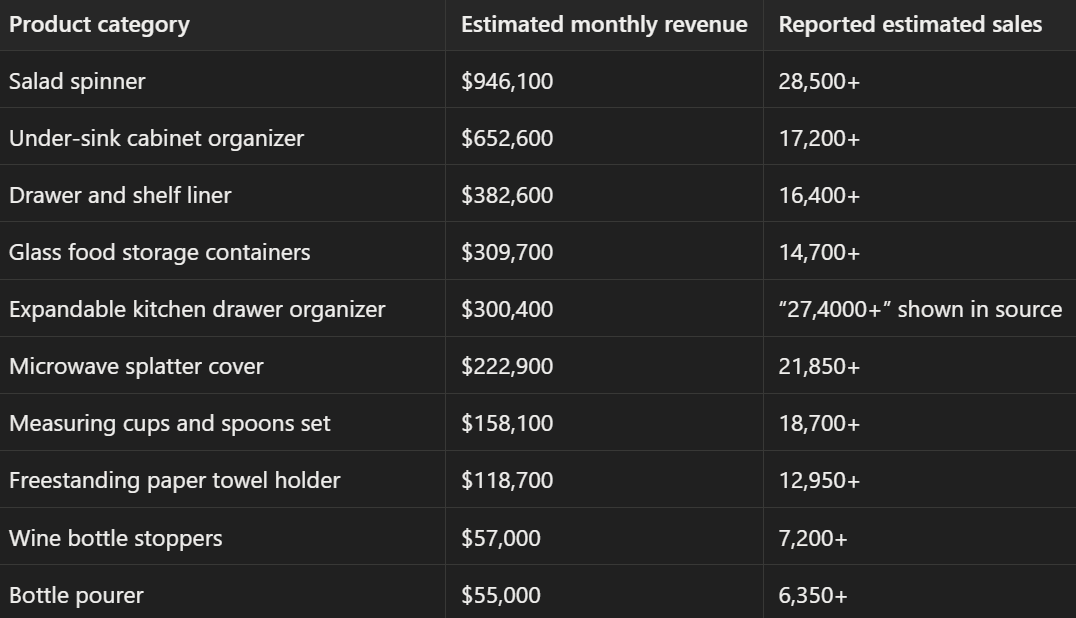
The fifth sales figure appears in the source as “27,4000+,” so it should not be silently corrected. The source headline also suggests that all products exceed 10,000 monthly sales, while the detailed figures for wine stoppers and bottle pourers are lower.
Four Commercial Patterns in Amazon Kitchen Products
1. Storage products solve a specific space problem
Under-sink organizers, drawer organizers, shelf liners, and glass food containers all address storage inefficiency.
Their commercial appeal comes from a simple value proposition: customers can make better use of existing cabinets, drawers, shelves, and refrigerators. These products also support specific long-tail searches, including:
- under-sink organizer
- kitchen drawer organizer
- shelf liner
- glass food storage containers with lids
For product research, these narrower terms are more useful because they represent specific customer needs and more clearly defined competitive niches.
2. Mess reduction creates repeat-use value
The salad spinner, microwave splatter cover, and paper towel holder are linked to cleaning and mess reduction.
This is commercially relevant because the customer problem occurs repeatedly. A product does not need advanced technology if it removes a frequent inconvenience. Product pages in this segment should explain the use case clearly instead of focusing only on materials or appearance.
3. Everyday tools can support practical purchase intent
Measuring cups, wine stoppers, and bottle pourers are smaller accessories, but each has a clear function.
These products may benefit from straightforward search intent. Consumers usually know what they want before visiting Amazon, which can make keyword targeting more direct. However, clear search intent also means that competing listings are easy to compare.
4. Competitive barriers determine long-term opportunity
Demand alone does not make a product attractive. A seller must also ask how difficult it will be to compete.
Kitchen products may have weak barriers when they are:
- Easy to copy
- Sold by many unbranded suppliers
- Competing mainly on price
- Nearly identical in appearance
- Dependent on one simple feature
Stronger defensibility may come from:
- A distinctive design
- Better material quality
- A patented or protected feature
- A trusted brand
- A useful bundle or accessory system
- Better packaging and lower breakage
- A clear improvement based on customer complaints
For example, a generic drawer organizer may have visible demand but limited defensibility. A redesigned organizer that solves a specific cabinet-size problem may create a stronger position.
What the Reported Numbers Mean
AMZ123 provides useful product-discovery data, but its figures should be treated as estimates.
Amazon publicly shows product information such as price, ratings, reviews, and sometimes Best Sellers Rank. However, Best Sellers Rank is a relative category ranking, not a public report of exact monthly unit sales or monthly revenue.
Amazon explains that Best Sellers Rank reflects sales performance compared with other products in the same category. Amazon’s sales-estimation guidance also describes estimates based on marketplace signals rather than direct access to a competitor’s private sales records.
Demand Is Only One Part of Product Opportunity
A product opportunity is not determined by demand alone. A more useful model is:
Demand × Margin × Differentiation × Operational Feasibility × Risk
Strong demand cannot compensate for permanently weak margins, severe compliance risk, or a product that can be copied instantly.
A More Complete Product Verification Checklist
Before sourcing any Amazon kitchen products, sellers should verify:
- Exact ASIN and product variation
Confirm that the researched product is the same size, color, pack count, and version. - Landed cost
Include product cost, packaging, freight, duties, prep fees, and Amazon fulfillment fees. - Contribution margin
Calculate profit after advertising, returns, discounts, storage, and platform fees. - Advertising pressure
Check expected PPC costs, sponsored listing density, and whether organic visibility is realistic. - Review moat
Compare review count, rating, review velocity, and recurring complaints among leading listings. - Return and damage risk
Glass containers, plastic parts, and large organizers may create breakage, defect, or dimensional-weight problems. - Compliance requirements
Identify whether the product is subject to food-contact, material, labeling, testing, or documentation requirements in the target marketplace. Requirements can vary significantly by material, intended use, and country. - Intellectual property risk
Check trademarks, design patents, utility patents, and distinctive product shapes before copying a feature. - Seasonality and demand stability
Determine whether demand is year-round or linked to holidays, weddings, entertaining, or seasonal cooking. - Supplier and MOQ risk
Review lead times, minimum order quantities, customization costs, and backup supplier availability. - Product differentiation
Identify a measurable improvement rather than relying only on a new color or logo. - Listing quality
Evaluate the product images, dimensions, instructions, comparison charts, and keyword coverage. After validating the opportunity, sellers can use listing-production tools such as BeePOP to create supporting visual assets, including main images, lifestyle images, benefit graphics, detail shots, and size references.
Conclusion
The AMZ123 list suggests that several types of kitchen products attract attention because they solve ordinary household problems. Storage products improve space usage, cleaning accessories reduce mess, and compact tools simplify recurring tasks.
However, the most important product-research question is not simply, “Is there demand?” It is:
Can a seller serve the demand profitably, comply with marketplace requirements, and defend the product against similar listings?
AMZ123 can provide an initial shortlist. Amazon product pages, ASIN-level checks, cost calculations, customer-review analysis, and competitive-barrier research are still necessary before making a sourcing decision.
FAQ
Are the AMZ123 sales figures official Amazon data?
No. They are third-party estimates reported by AMZ123. Amazon does not generally disclose exact monthly sales and revenue for competing sellers.
Are all 10 products selling more than 10,000 units per month?
No. The source lists 7,200+ estimated units for wine bottle stoppers and 6,350+ for bottle pourers. The headline and detailed figures are not fully consistent.
Is a high sales estimate enough to justify sourcing?
No. A product may have strong estimated demand but weak margins, intense PPC competition, high return rates, compliance risk, or no meaningful differentiation.
Why is the ASIN important?
The ASIN identifies a specific Amazon listing. Without it, sellers may accidentally compare different products, sizes, pack counts, or variations.