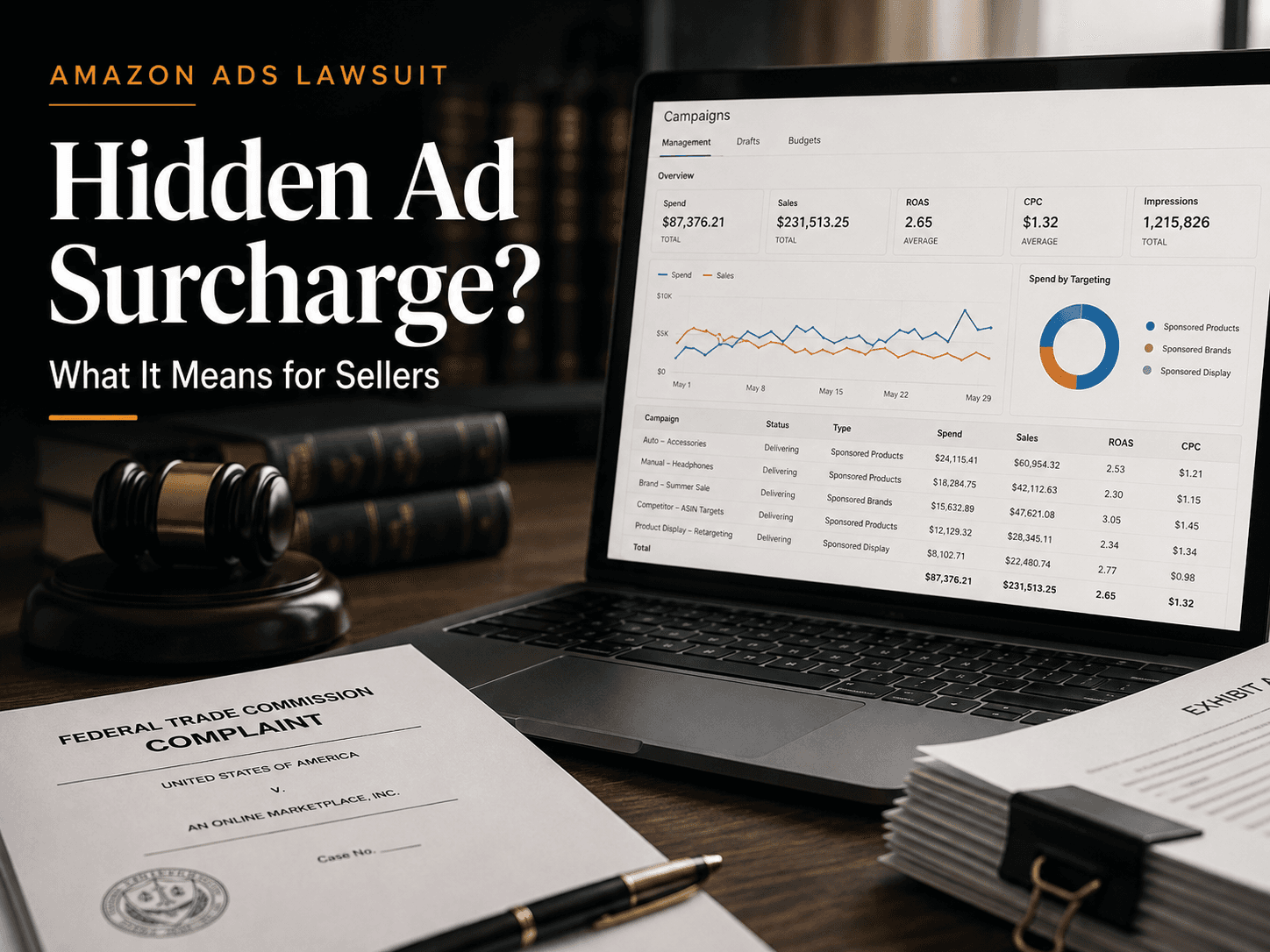
On August 31, 2026, the Federal Trade Commission and 22 states filed a lawsuit against Amazon over its advertising auction system.
The complaint alleges that Amazon secretly increased advertising costs through undisclosed pricing adjustments in auctions for Sponsored Products, Sponsored Brands, and Display Ads. The FTC says the alleged conduct affected more than one million brands and sellers, including more than 500,000 small and medium-sized businesses.
New York Attorney General Letitia James separately described the alleged overcharges as exceeding $20 billion and said more than 1.2 million advertising customers may have been affected. These are allegations in an ongoing case, not final court findings.
Amazon denies the allegations and says the FTC’s case misunderstands how its Sponsored Ads auction works.
What Is the Amazon FTC Lawsuit About?
At the center of the case is a disagreement over how Amazon explains and operates its ad auctions.
Amazon has presented its advertising system as a relevance-based auction. In a simplified generalized second-price auction, the winning advertiser typically pays an amount influenced by the next-highest competing bid rather than automatically paying its full maximum bid.
The FTC’s allegations concern a separate issue: whether Amazon added undisclosed pricing adjustments to that auction process.
According to the FTC complaint, Amazon allegedly introduced an internal “soft reserve price” beginning in 2019. The New York Attorney General’s account traces the alleged manipulation to 2018 and describes the use of fake or artificial second-place bids.
The important distinction is this:
The lawsuit is not simply about how second-price auctions work. It is about whether Amazon’s actual pricing mechanics differed from what advertisers were told.
The FTC alleges that Amazon’s nominally second-price Sponsored Products auctions effectively became first-price auctions in many cases, causing advertisers to pay close to their own winning bids. The complaint alleges that advertisers paid their own bid close to 80% of the time for Sponsored Products in 2024.
These claims will be tested through the court process. The FTC case page lists the matter as pending.
The Auction Question at the Center of the Case
Amazon advertising auctions involve several moving parts, including:
- Advertiser bids
- Keyword relevance
- Expected ad performance
- Product information
- Placement
- Shopper behavior
- Auction pricing rules
Advertisers generally see the result of the auction through metrics such as impressions, clicks, CPC, spend, sales, ACOS, and ROAS. They do not necessarily see every internal variable used to calculate the final price.
The FTC alleges that Amazon used hidden pricing adjustments that went beyond genuine advertiser competition. The complaint refers to an “invented auction participant” and a “proxy second price” that allegedly increased the price paid by advertisers.
This creates two different questions:
- How does Amazon rank and select an ad?
- How does Amazon determine the final price charged to the winning advertiser?
The first question concerns auction ranking and ad relevance. The second concerns price formation. Keeping these issues separate is essential to understanding the lawsuit.
What Amazon Says About Its Advertising System
Amazon strongly disputes the FTC’s interpretation.
The company says its Sponsored Ads system is designed to prioritize relevance rather than simply selecting the highest bid. Amazon claims that average cost per click for Sponsored Products remained flat after inflation adjustment from 2019 through 2024, while conversion rates improved.
Amazon also says that:
- Advertisers never pay more than their bid.
- Average winning bids for Sponsored Products fell between 2019 and 2025.
- Most placed ads are not awarded solely to the highest bidder.
- Advertisers achieved stronger sales and return on ad spend under Amazon’s relevance-focused model.
These figures are Amazon’s own representations and are likely to become part of the dispute as the case develops.
What Could the Lawsuit Mean for Amazon Sellers?
The immediate outcome is uncertain, but the case could affect how sellers understand advertising data and manage campaign profitability.
1. Greater demand for auction transparency
Advertisers may ask Amazon for clearer explanations of how bids, relevance, placement, reserve prices, and final CPC interact.
If the case results in new disclosures or reporting requirements, sellers could gain more visibility into how their advertising costs are formed.
2. More scrutiny of historical CPC data
Many sellers use CPC changes to judge keyword competition. A sudden rise in CPC is often interpreted as evidence that:
- More advertisers are competing for the keyword
- The keyword has greater commercial value
- The category is becoming more saturated
- Campaign efficiency is declining
The lawsuit raises the possibility that CPC may also reflect platform-level auction mechanics. That makes long-term comparisons more difficult, especially for campaigns running across several years.
3. More pressure on campaign profitability
A higher CPC can reduce profit even when sales remain stable. Sellers may therefore need to evaluate advertising costs alongside:
- Conversion rate
- ROAS
- ACOS
- Product margin
- Fulfillment costs
- Discounts
- Returns
- Contribution margin
The legal dispute may ultimately be less important to day-to-day campaign management than the broader question of whether sellers have enough information to make profitable bidding decisions.
The Bigger Question: Can Sellers Trust CPC as a Market Signal?
For years, Amazon sellers have used CPC as a practical signal of marketplace competition.
A high CPC may suggest that a keyword is competitive, commercially valuable, or difficult to win. However, if auction mechanics or undisclosed pricing adjustments can also influence the final price, then CPC may not represent pure market competition.
In simple terms:
CPC does not necessarily equal pure market competition.
CPC may reflect a combination of:
- Advertiser competition
- Keyword demand
- Ad relevance
- Placement
- Auction design
- Pricing adjustments
- Seasonal shopping activity
That does not make CPC useless. It means sellers should avoid interpreting it in isolation.
A stronger evaluation framework combines:
- CPC to understand the cost of traffic
- CVR to measure how efficiently traffic converts
- ROAS to evaluate advertising return
- Contribution margin to determine whether the campaign is actually profitable
For example, a keyword with a rising CPC may still be worth scaling if conversion rate and contribution margin are strong. Conversely, a keyword with an acceptable CPC may still be unprofitable if conversion declines or product costs increase.
The practical lesson is that Amazon advertisers should treat CPC as one part of a larger performance system, not as a complete measure of competition or keyword value.
What Should Amazon Advertisers Do Now?
Sellers do not need to redesign every campaign simply because the lawsuit was filed. However, they can take several practical steps.
- Preserve historical advertising reports where available.
- Compare bid amounts with actual CPC over time.
- Track CPC together with CVR, ROAS, ACOS, and contribution margin.
- Compare placement-level performance instead of relying only on campaign averages.
- Monitor official FTC, state, and Amazon updates before assuming refunds or compensation.
Advertisers should also monitor official updates from the FTC, state attorneys general, and Amazon as the litigation progresses.
Conclusion
The Amazon FTC lawsuit 2026 is not merely a dispute over advertising prices. It raises a broader issue about transparency in retail media auctions and the reliability of the data sellers use to make bidding decisions.
The FTC and state attorneys general allege that Amazon used hidden surcharges and undisclosed auction adjustments to increase advertising costs. Amazon denies wrongdoing and argues that its relevance-focused system produced better results for advertisers.
For sellers, the most useful takeaway is practical: CPC should not be viewed as a standalone measure of competition. Sellers should evaluate CPC alongside conversion rate, ROAS, and contribution margin before making major campaign decisions.
The case remains pending, and any future changes to Amazon Ads will depend on court rulings, settlements, or possible regulatory action.
FAQ
Why is the FTC suing Amazon?
The FTC and 22 states allege that Amazon used undisclosed pricing practices to inflate the cost of advertising auctions on its platform.
Did Amazon overcharge advertisers?
The lawsuit alleges that Amazon overcharged advertisers and that the total impact could exceed $20 billion. This remains an allegation and has not been finally determined by a court.
Does the lawsuit affect Sponsored Products?
Yes. The case concerns Amazon’s broader advertising auction system, including Sponsored Products, Sponsored Brands, and Display Ads.
Will Amazon advertisers receive refunds?
There is currently no confirmed refund program connected to this lawsuit. Any compensation would depend on a future court order, settlement, or official claims process.
Should sellers stop using Amazon Ads?
Not necessarily. Sellers should continue evaluating campaigns based on actual profitability, including CPC, CVR, ROAS, ACOS, and contribution margin. The lawsuit alone does not establish that every Amazon advertising campaign is unprofitable.
Sources
- FTC case page: Amazon advertising surcharge lawsuit
- FTC press release: FTC, States Sue Amazon Over Secret Ad Surcharge Scheme
- FTC complaint filed in the U.S. District Court for the Western District of Washington
- New York Attorney General’s press release on alleged advertiser overcharges
- Amazon’s response to the FTC lawsuit regarding Sponsored Ads