A product image can have perfect lighting, a convincing background, and polished copy while still getting something essential wrong: the number of pieces in the box.
For an Amazon seller, that image isn't ready to publish.
OpenAI's recent research on low-resource programming languages highlights an important distinction: AI output needs to meet the requirements of a task, not just appear complete.
Although the research focuses on software engineering, it offers a useful lesson for sellers creating AI product images, Amazon listings, and other e-commerce content.
What OpenAI Announced
On October 19, 2026, OpenAI reported improvements in coding with low-resource programming languages, including COBOL, Fortran, and Visual Basic.
These languages have less training data available than widely used alternatives such as Python.
OpenAI reported results from two evaluations:
- MultiLangBench: Models build a SQLite-compatible database engine across 20 programming languages. At maximum reasoning effort, GPT-6 Astra achieved an average test pass rate of 87.4%, compared with 26.8% for GPT-5.6 Sol.
- COBOL migration: Models translate existing programs into other languages while preserving their outputs. GPT-6.1 Sol achieved 86.6% accuracy at low reasoning effort and 97.9% at higher effort. A migration passed only after meeting all hidden tests.
The COBOL evaluation offers a particularly useful distinction. A rewritten program must preserve the original program's behavior, not simply run successfully.
These results measure coding performance, not image generation. But they illustrate why checking AI output against specific requirements matters.
Why This Matters for AI Product Images
Imagine you're selling a black mounting bracket set on Amazon.
The package includes two brackets and four screws. You need a white-background product image, a lifestyle scene, a dimensions graphic, and an image showing what's included.
Each image serves a different purpose, but all four must represent the same product.
The background, lighting, and layout can change. The product's finish, mounting holes, dimensions, and included quantities should not.
If an AI-generated image shows three brackets instead of two, it may look professional while giving shoppers inaccurate information.
An attractive image of the wrong product is still unfinished work.
The connection to OpenAI's research is about preserving essential information. Just as a migrated program must maintain its intended behavior, AI-generated product content must accurately represent the product customers will receive.
For Amazon sellers, this means evaluating images against verified product facts, not appearance alone.
Start With an Accurate Product Brief
Before generating AI product images, prepare a brief for the exact SKU you're selling.
Include:
- Reference images: Clear photos of the product and important details.
- Specifications: Verified dimensions, materials, and finish.
- Package contents: Exact quantities and included accessories.
- Compatibility: Confirmed uses and supported applications.
- Product claims: Features and benefits supported by product information.
- Image requirements: The purpose of each image in the listing.
For the mounting bracket example, specify the black finish, two-bracket package, four included screws, and approved measurements rather than simply requesting a premium product image.
This gives both the AI workflow and the reviewer a consistent reference.
Review AI-Generated Images as a Complete Set
An individual product image can appear accurate while the full listing contains inconsistencies.
For example, one image might show the correct accessories while another introduces an extra component.
Review the complete image set against the same product brief.
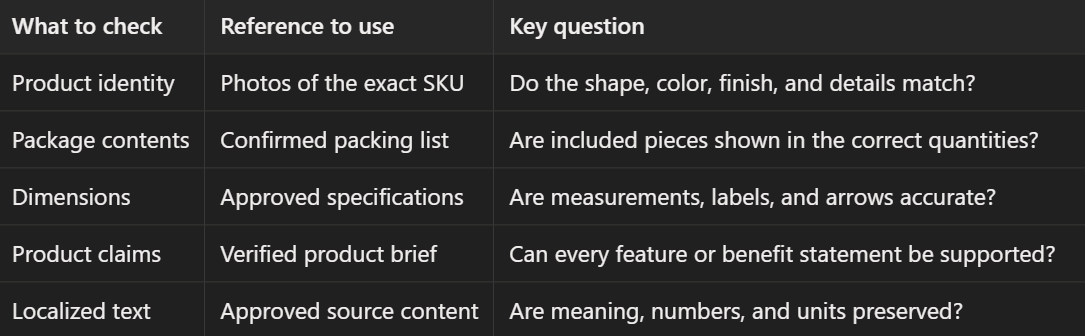
Add category-specific checks where necessary, particularly for replacement parts, multi-piece kits, or products with similar variants.
Measure the Time Needed to Approve Product Images
Fast generation doesn't always mean faster production.
Preparing inputs, reviewing images, correcting mistakes, and exporting approved files all contribute to the workload.
A useful metric is:
Minutes per approved image = Total time from preparation to final export ÷ Number of approved images
Test the workflow with a few representative SKUs, including a simple product, a kit with accessories, and an item with similar-looking variants.
Record revision reasons alongside approval time. Repeated quantity errors may indicate unclear package references, while recurring variant mistakes may point to poorly organized source photos.
These findings help teams improve the process instead of repeatedly fixing the same problems.
Applying This Workflow With BeePOP
BeePOP helps e-commerce sellers create product visuals from source photos and product descriptions, including white-background images, lifestyle scenes, selling-point graphics, and Amazon A+ Content.
Start with one SKU and its verified product brief. Generate an image set, then compare the results against the original references before approving them for use.
If an image needs adjustment, BeePOP's single-image editing feature allows sellers to revise a selected image without regenerating the entire set.
For international marketplaces, Multi-Locale Image Generation supports translating text within individual images or complete image sets.
Review edited and localized images for product accuracy, text readability, meaning, and measurement units before publishing.
These tools can simplify parts of the image production workflow, while final approval remains an important step for sellers.
FAQ
What are low-resource programming languages?
Low-resource programming languages have relatively less code and documentation available for AI training than widely used languages such as Python. OpenAI's research discusses examples including COBOL, Fortran, and Visual Basic.
How is OpenAI's research relevant to AI product images for Amazon?
The connection is about evaluating results against requirements. OpenAI's coding evaluations test whether generated or migrated software produces the expected outputs. Amazon sellers can apply a similar principle by checking whether AI-generated product images preserve verified product details. The research itself does not evaluate image-generation accuracy.
Can BeePOP edit and localize AI-generated product images?
Yes. BeePOP supports editing individual generated images and translating image text for supported markets and languages. Sellers should review the final results before publishing.