Grok 4.7 is SpaceXAI’s latest model for coding and knowledge work. The company published the launch post on September 21, 2026, and put the model in Cursor, Grok Build, and the Grok API the same day. GitHub also began rolling it into Copilot.
This article sticks to official product pages and docs. Benchmark scores below are SpaceXAI’s published numbers, not independent re-runs.
What Grok 4.7 is
SpaceXAI describes Grok 4.7 as its most capable model for coding and knowledge work. The launch post says it can stay on difficult tasks longer, check its own work more carefully, and ship with the company’s “best-calibrated safeguards to date.” It is served at the same starting price and speed as Grok 4.6.
The public API model ID is grok-4.7. Official docs list:
- Input: text and images
- Output: text
- Context window: 500,000 tokens
- Function calling: yes
- Structured outputs: yes
- Reasoning: yes
- Reasoning efforts:
low,medium,high,xhigh - Default reasoning effort:
high - Batch API: not supported
Rate limits in the model docs are 150 requests per second and 50,000,000 tokens per minute. The Grok 4.7 model card also lists cluster regions such as us-east-1. That cluster field is not the same thing as the US regional endpoint (us.api.x.ai).
What changed from Grok 4.6
SpaceXAI says Grok 4.7 uses a new, larger base model than Grok 4.6. Training included a longer reinforcement learning run on a harder task mix, with more weight on problems that take many hours. The company also says the model is better at verifying its own work, managing longer context, writing documents and presentations, and using the Grok Bot harness.
Those are vendor claims. What you can check today is the published spec, price card, and the benchmark tables on the launch page.
Official benchmark table
On the launch page, SpaceXAI compared Grok 4.7 xHigh, Grok 4.6 High, GPT-5.6 Sol Max, and Fable 5.1 Max:
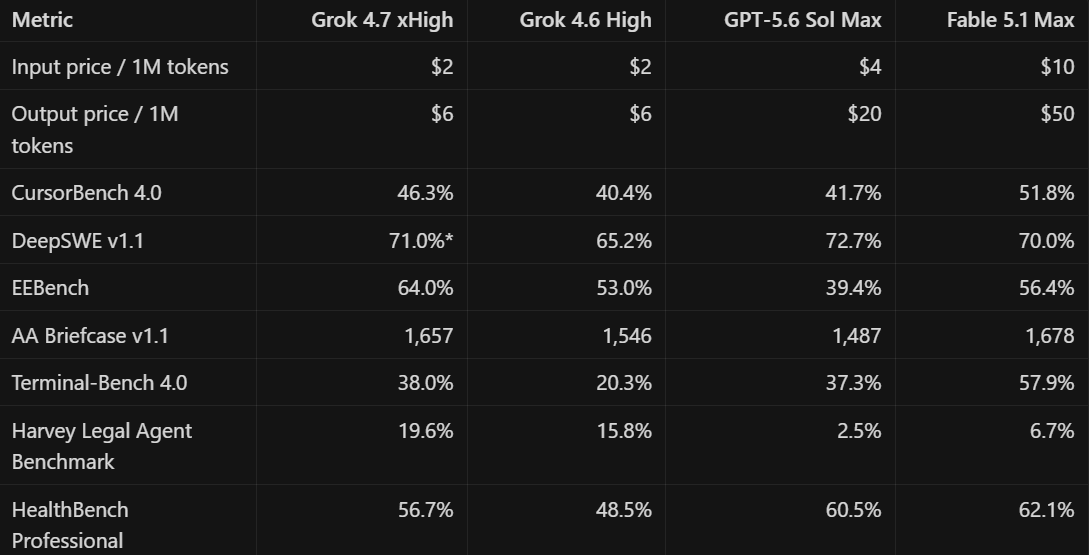
SpaceXAI marks the Grok 4.7 DeepSWE score as high effort.
A few plain readings of that table:
- Grok 4.7 does not lead every software-engineering score. Fable 5.1 Max is ahead on CursorBench 4.0 (51.8% vs 46.3%) and Terminal-Bench 4.0 (57.9% vs 38.0%).
- SpaceXAI’s own framing is price-performance, not raw first place. On CursorBench 4.0 it reports Grok 4.7 Extra High at 46.3% and about $6.01 average cost per task.
- The largest published jumps vs Grok 4.6 High are EEBench (53.0% to 64.0%), Terminal-Bench 4.0 (20.3% to 38.0%), and Harvey Legal (15.8% to 19.6%).
- HealthBench Professional is one place Grok 4.7 trails the other two frontier rows (56.7% vs 60.5% and 62.1%).
GDPval is a second chart, with a different lineup
The launch page also has a separate knowledge-work chart. Its caption says it compares Grok 4.7 with Grok 4.6, Fable 5.1, and GPT-6 Astra. That is not the GPT-5.6 Sol Max row from the table above. SpaceXAI published both names on the same page.
GDPval Elo scores on that chart:
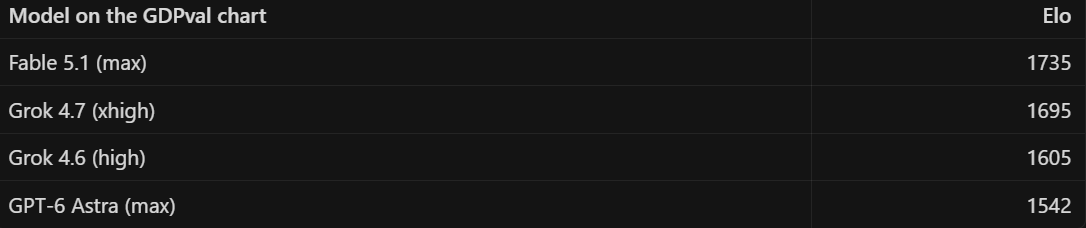
SpaceXAI says Grok 4.7 improved on Grok 4.6 in GDPval and AA Briefcase, which cover professional tasks such as work done by lawyers, nurses, and financial analysts. Do not mix GPT-6 Astra Max into the software-engineering table, or GPT-5.6 Sol Max into this GDPval chart.
Pricing
Standard API (grok-4.7)
Docs price the public API as follows. If a prompt reaches 200,000 tokens, the higher rate applies to all tokens in that request.

That matches the launch-page starting price: $2 per million input tokens and $6 per million output tokens, the same starting rates as Grok 4.6.
Grok 4.7 Fast
The launch post says SpaceXAI also serves a fast variant with about twice the output speed at twice the price. Docs are more specific:
- Fast is the same Grok 4.7 model on faster infrastructure.
- It is available only in Cursor and Grok Build.
- It is not on the public xAI API.
- Grok Build’s free tier does not include Fast.

Cursor bills its own fast variant through the Cursor plan.
US regional endpoint
The US endpoint is https://us.api.x.ai/v1. Token usage is billed at 1.1x global rates. The 10% premium applies to input, output, and cached input, including long-context rates.
This article does not treat model availability there as one settled sentence, because official pages describe it in different places and the live list can change.
What the docs said when this article was checked:
- Regional Endpoints (updated September 21, 2026) says the US endpoint currently serves two models,
grok-4.7andgrok-4.6, and none of the image, video, or voice APIs. It also says the console models page andGEThttps://us.api.x.ai/v1/modelsalways show the current list. A model that is not on that list returns 404. - API Pricing gives US-endpoint rates for
grok-4.7: $2.20 / $0.55 / $6.60 per million tokens (input / cached input / output) below 200k prompt tokens, and $4.40 / $1.10 / $13.20 above. - Security FAQ currently says the US endpoint serves only
grok-4.7andgrok-4.6. - The Grok 4.7 model card’s
us-east-1/ cluster region field is a different concept. Do not read that as proof thatus.api.x.aiis live for your team.
If you need US processing for residency, confirm the live model list before you ship. Regional Endpoints is explicit that the /models response, not a blog post, is the current list.
What the API does not include
- Batch API is not supported for
grok-4.7. - The 20% batch discount list in the pricing docs does not include Grok 4.7.
Safety claims
SpaceXAI says Grok 4.7 uses a new safeguard stack and is the strongest model it has tested on refusals and jailbreak resistance.
On dual-use work (cybersecurity and biological research), the company says the model leads on both utility for benign tasks and refusal of dangerous ones. It reports 62.4% on LatchBio’s biosafety benchmark.
On HackerBench v0.3, SpaceXAI’s benchmark for risky and malicious cyber tasks, it says Grok 4.7 allowed 3.3% of risky dual-use prompts through, while rarely blocking legitimate security work. The company also says it has started giving selected cybersecurity partners invite-only access to Grok 4.7 red-team capabilities for defense research.
Those safety figures are vendor-reported.
Where you can use it
SpaceXAI says Grok 4.7 is available now in:
- Cursor
- Grok Build
- the Grok API
- third-party coding harnesses
- model routers and cloud platforms
The launch post points to a free Grok Build starting point at x.ai/build. That is not the same as free Fast access, and it is not the same as free public API usage.
GitHub’s changelog, also dated September 21, 2026, says Grok 4.7 is rolling out in GitHub Copilot for Copilot Pro, Pro+, Max, Business, and Enterprise. GitHub lists the model picker in Visual Studio Code, Visual Studio, Copilot CLI, Copilot cloud agent, the Copilot app, JetBrains, Xcode, and Eclipse. Rollout is gradual. Copilot bills it at provider list pricing under usage-based billing. Business and Enterprise admins can allow or block it in Copilot model policy.
How to start
- Product users: open the model picker in Cursor, or start at x.ai/build.
- API users: create a key in the console and call model ID
grok-4.7. Docs live at docs.x.ai. - Copilot users: check the model picker. If it is missing, GitHub says the rollout is still landing.
Is Grok 4.7 worth using?
Yes, as a default upgrade from Grok 4.6. Same starting API price, same 500,000-token context class, and SpaceXAI’s own table shows gains on most of the published suite. It is not the model to pick if you only care about the single highest software-engineering score.
Who should use the Grok 4.7 API.
Use grok-4.7 if you are building agents or apps and want the public model ID, function calling, structured outputs, and image-in / text-out at $2 / $6 per million tokens. That path fits production workloads that need a stable API, GitHub Copilot, or third-party routers. Do not choose the API if your main need is Fast. Docs say Fast is not on the public API, and Batch is not supported. If you need the US endpoint, confirm grok-4.7 on GET https://us.api.x.ai/v1/models first.
Who should use it in Cursor.
Use Cursor (or Grok Build) if the work is long-running coding inside an editor, or if you want the Fast serving option. SpaceXAI’s CursorBench 4.0 chart is the relevant vendor number here: Grok 4.7 Extra High is 46.3% at about $6.01 average cost per task. That is the price-performance pitch, not a claim that it beats Fable 5.1 Max on raw score.
Is Fast worth 2x the price?
Only when output speed is the bottleneck and you are already in Cursor or Grok Build. Official docs price Fast at $4 / $12 per million tokens below 200k prompt tokens, versus $2 / $6 for standard. It is the same model on faster infrastructure, not a higher-quality model. Skip Fast if you are on the public API, on Grok Build’s free tier (Fast is excluded), or if you need xhigh quality more than lower latency.
Is the jump from Grok 4.6 worth it?
For most users, yes. Starting prices match Grok 4.6, so the migration cost is mainly validation, not a new rate card. On SpaceXAI’s table, Grok 4.7 xHigh moves CursorBench 4.0 from 40.4% to 46.3%, EEBench from 53.0% to 64.0%, Terminal-Bench 4.0 from 20.3% to 38.0%, Harvey Legal from 15.8% to 19.6%, and GDPval Elo from 1605 to 1695. Stay on 4.6 only if you already pinned prompts, evals, or routing to that model and have no regression budget.
When to pick something else.
Stay with another frontier model when the official charts themselves say Grok 4.7 is behind. Fable 5.1 Max leads the software-engineering table on CursorBench 4.0 (51.8% vs 46.3%) and Terminal-Bench 4.0 (57.9% vs 38.0%), at a much higher token price. GPT-5.6 Sol Max leads DeepSWE v1.1 in that same table (72.7% vs Grok 4.7’s high-effort 71.0%). HealthBench Professional is also not a Grok 4.7 lead (56.7% vs 60.5% and 62.1%). On the separate GDPval chart, Fable 5.1 Max still leads (1735 vs 1695). If the job is “highest score, cost is secondary,” the launch page does not say to choose Grok 4.7.
Short verdict.
Default to Grok 4.7 over Grok 4.6. Use the API for apps and integrations. Use Cursor when you want Fast or editor-native coding. Pay for Fast only to buy speed. Keep a more expensive model in the mix for max SWE scores or clinical-benchmark work.
FAQ
What is Grok 4.7?
It is SpaceXAI’s September 2026 frontier model for coding, agentic tasks, and knowledge work. The public model name is grok-4.7.
How much does Grok 4.7 cost?
The standard public API starts at $2 per million input tokens and $6 per million output tokens. Cached input is $0.50 per million. Prompts at or above 200,000 tokens are billed at $4 / $1 / $12 per million (input / cached input / output) for the whole request.
What is Grok 4.7 Fast?
Docs say it is the same model served on faster infrastructure, at higher token rates, only in Cursor and Grok Build. It is not on the public API, and it is not in Grok Build’s free tier.
Is Grok 4.7 better than Grok 4.6?
SpaceXAI reports gains on the launch-page suite, including CursorBench 4.0 (46.3% vs 40.4%), EEBench (64.0% vs 53.0%), and GDPval Elo (1695 vs 1605). Starting API prices are the same. That is the vendor comparison, not a third-party bakeoff.
Sources
- SpaceXAI, Introducing Grok 4.7 (September 21, 2026): https://x.ai/news/grok-4-7
- SpaceXAI Docs, Grok 4.7 model card: https://docs.x.ai/developers/models/grok-4.7
- SpaceXAI Docs, API Pricing: https://docs.x.ai/developers/pricing
- SpaceXAI Docs, Regional Endpoints: https://docs.x.ai/developers/advanced-api-usage/regions
- GitHub Changelog, Grok 4.7 is now available in GitHub Copilot (September 21, 2026): https://github.blog/changelog/2026-09-21-grok-4-7-is-now-available-in-github-copilot/