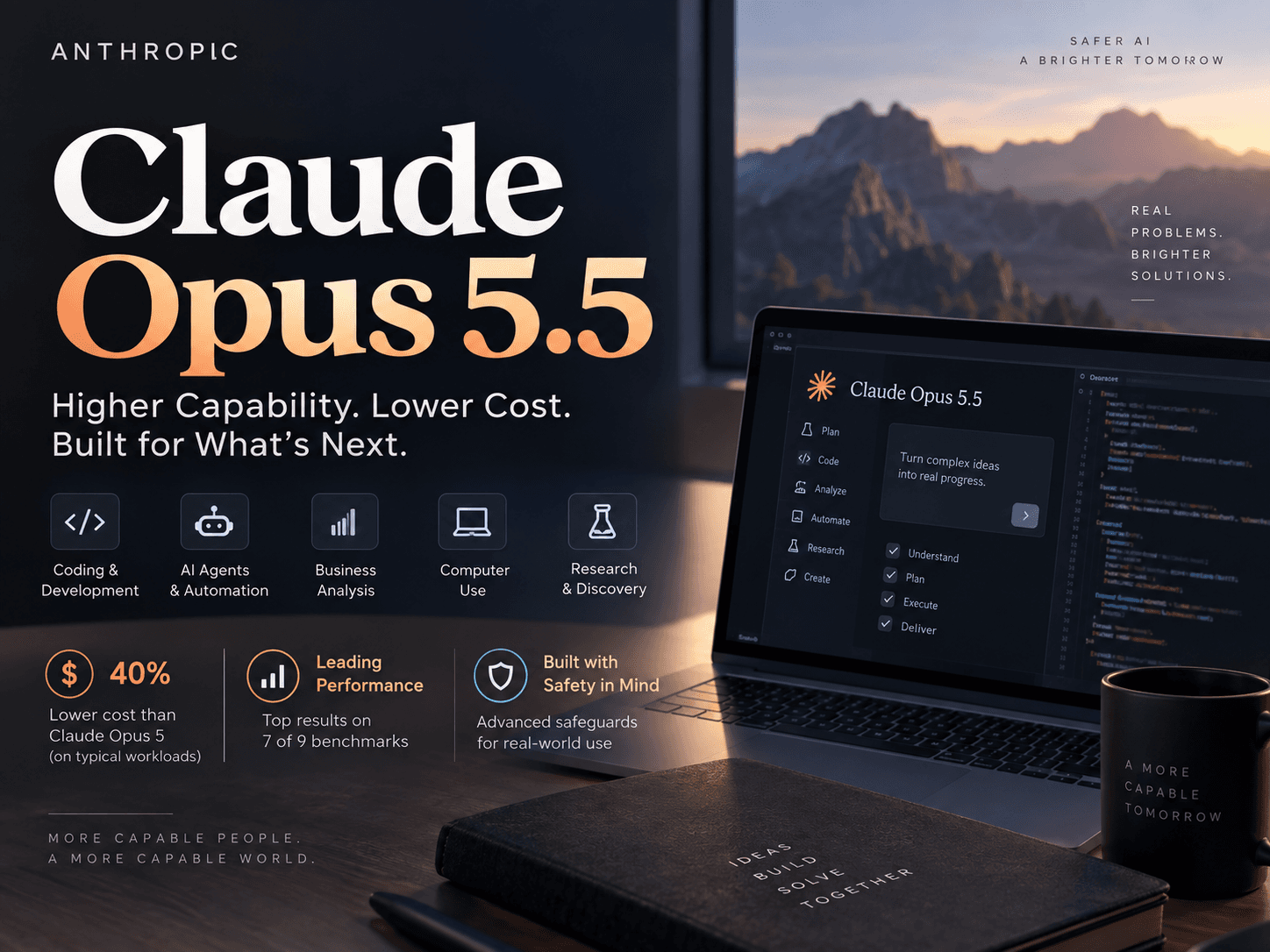
Key features of Claude Opus 5.5
Claude Opus 5.5 is designed for work that involves multiple steps, extended context, external tools, or long execution times.
Anthropic highlights several practical use cases:
- Large-scale code migration
- Debugging and codebase refactoring
- Automated code review
- Multi-step business analysis
- Financial and operational reporting
- Computer-use automation
- Long-running software agents
- Research and data collection
The model is also designed to produce clearer responses. Anthropic says it puts important information first, reduces unnecessary jargon, and follows user-defined writing requirements more consistently.
Claude Opus 5.5 benchmark results
Anthropic’s comparison includes Claude Opus 5.5, Claude Fable 5.1, Claude Opus 5, GPT-6 Astra, and GPT-5.6 Sol.
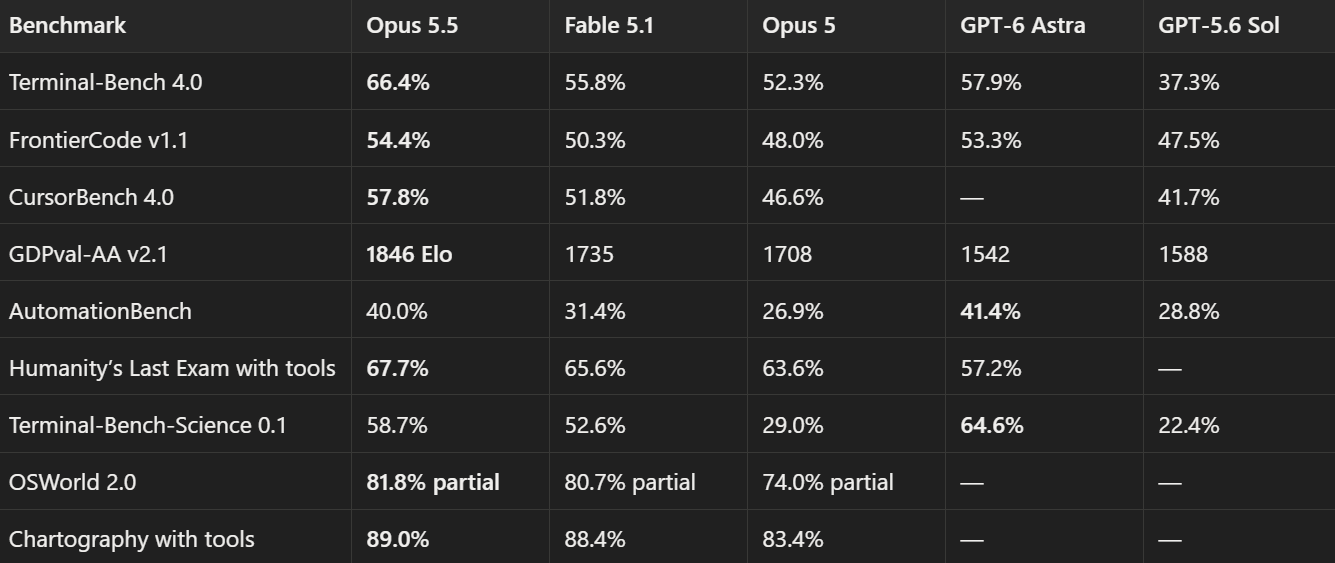
Claude Opus 5.5 records the highest score among the listed models in seven of the nine rows. GPT-6 Astra scores higher on AutomationBench and Terminal-Bench-Science 0.1.
This comparison also requires methodological context. Most Opus 5.5 results use adaptive thinking at maximum effort. Terminal-Bench 4.0 uses xhigh effort for Opus 5.5, while the GPT-6 Astra result is reported at high effort. These settings are not identical, so the table should be read as a comparison under different evaluation configurations, not as a universal ranking.
Anthropic also reports an uncertainty range of approximately ±3.5–5 percentage points per model on Terminal-Bench-Science. That makes small differences on this benchmark difficult to interpret with confidence.
Coding and software development
Coding is one of the main areas where Anthropic expects Claude Opus 5.5 to be used.
The model is intended for tasks such as:
- Repository-wide migrations
- Multi-file refactoring
- Debugging
- Code audits
- Performance optimization
- Long-running coding-agent sessions
Anthropic reports that an early tester completed a migration involving 680,000 lines of code in less than a day. In another internal test, Opus 5.5 completed an HAProxy migration from C to Rust in 9.5 hours, compared with 12 hours for Claude Fable 5.1. Anthropic says the Opus 5.5 run cost 51% less in that test.
These examples illustrate the type of work Anthropic is targeting, but they do not guarantee the same results for every repository, programming language, or development environment.
Claude Opus 5.5 pricing
Anthropic lists the following standard API prices:
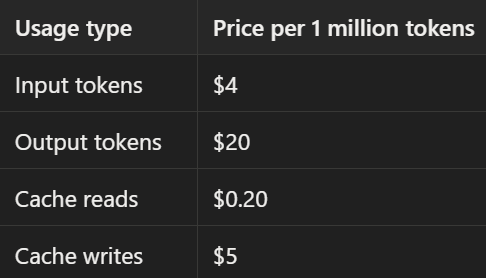
For comparison, Claude Opus 5 is listed at $5 per million input tokens and $25 per million output tokens. Anthropic estimates that Opus 5.5 costs around 40% less than Opus 5 on typical token-billed workloads.
Actual spending will depend on prompt size, output length, cache usage, tool calls, reasoning effort, retries, and the number of tasks completed successfully.
Fast Mode pricing
Anthropic also offers Fast Mode for Claude Opus 5.5 in Claude Code and on the Claude Platform.
Fast Mode is listed at:
- $8 per million input tokens
- $40 per million output tokens
Anthropic says Fast Mode can provide up to 2.5 times the speed of standard processing.
Safety safeguards and model routing
Claude Opus 5.5 was tested with Anthropic’s production safeguards enabled. When a safeguard intervened, some tasks were routed to other Claude models:
- Cybersecurity tasks were completed by Claude Opus 4.8.
- Biology and frontier large-language-model development tasks were completed by Claude Opus 5.
Anthropic says this routing may have affected Opus 5.5’s benchmark results. AutomationBench was run without fallback models, meaning safeguard interventions were counted as failures.
For production use, organizations should still apply permission controls, monitoring, human review, sandboxing, and rollback procedures when the model can access code, files, external tools, or sensitive data.
Claude Opus 5.5 API and availability
The API model identifier is:
claude-opus-5-5
Anthropic says the model is available through Claude for Pro, Max, Team, and Enterprise users, as well as through the Claude Platform, Amazon Web Services, Google Cloud, and Microsoft Foundry.
Anthropic also lists US-only inference at 1.1 times the standard input and output token price for workloads that must run in the United States.
Who should consider Claude Opus 5.5?
Claude Opus 5.5 is most relevant to users who need:
- Complex coding agents
- Large codebase transformations
- Multi-step tool use
- Business and financial analysis
- Computer-use automation
- Long-running research workflows
- Workflows where reducing retries and human review matters
For simple summaries, short translations, or basic text generation, a smaller model may offer better cost efficiency.
Conclusion
Claude Opus 5.5 is positioned as a high-end model for complex agentic work, especially coding, computer use, and professional analysis. Its main commercial advantages are strong reported benchmark performance and lower pricing than Claude Opus 5.
The most important qualifications are the evaluation settings, safeguard-based model routing, and benchmark uncertainty. Teams considering deployment should test the model on representative tasks and measure not only benchmark scores, but also cost per completed task, latency, failure rate, and human review time.
FAQ
How much does Claude Opus 5.5 cost?
Claude Opus 5.5 costs $4 per million input tokens and $20 per million output tokens. Cache reads cost $0.20 per million tokens, while cache writes cost $5 per million tokens.
Is Claude Opus 5.5 better than GPT-6 Astra?
It depends on the benchmark. Opus 5.5 scores higher in several categories, while GPT-6 Astra scores higher on AutomationBench and Terminal-Bench-Science 0.1.
Is Claude Opus 5.5 good for coding?
Anthropic designed it for code migration, debugging, refactoring, code review, and long-running coding-agent workflows. Actual performance depends on the repository and development setup.
What is the Claude Opus 5.5 API model name?
The API model identifier is claude-opus-5-5.
Does Claude Opus 5.5 always complete tasks itself?
No. Anthropic says some cybersecurity, biology, and frontier-model-development tasks may be routed to other Claude models when safety safeguards intervene.
Sources
- Introducing Claude Opus 5.5 — benchmarks, pricing, coding examples, evaluation settings, and safety details.
- Claude Opus — API access, availability, pricing, and platform information.
- Claude Fable — model information and product context.